
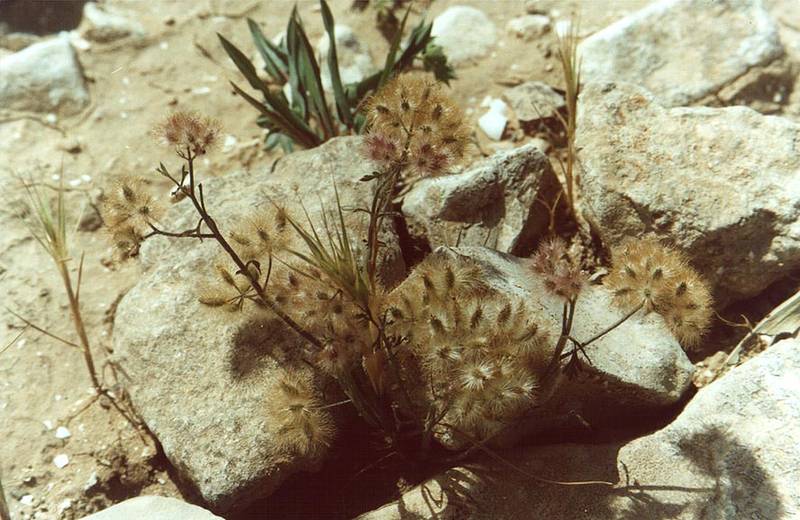

Negev Desert 1-2 miles north-east from Beer-Sheva. The Middle East


Album 131: Bedouin Market, Negev Desert in Beer-Sheva, trip to Jericho, April 13 - 15, 2000
The image depicts a rocky, arid landscape with sparse vegetation. In the foreground, several large rocks are scattered across the ground, some of which appear to be covered in a thin layer of sand or dust. The background is dominated by a vast expanse of dry, cracked earth that stretches out to the horizon.
Several small plants and shrubs can be seen growing amidst the rocks, but they seem to be struggling to survive in this harsh environment. Some of the plants have long, thin stems and sparse foliage, while others appear to be more robust, with thicker stems and fuller leaves.
The overall atmosphere of the image is one of desolation and drought. The dry, cracked earth and sparse vegetation suggest that this area has been affected by a prolonged period of drought or water scarcity. Despite these challenging conditions, some hardy plants have managed to adapt and survive in this unforgiving environment. – AI vision


