
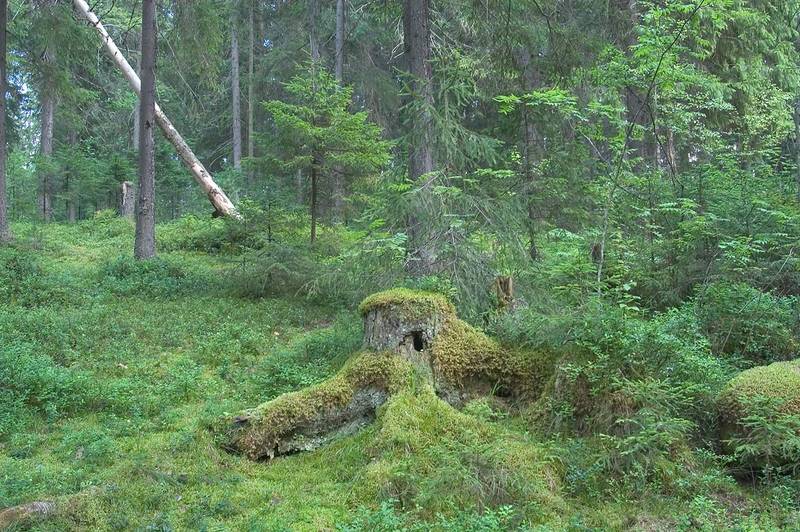

A forest north from Lembolovo, 30 miles north from St.Petersburg. Russia


Album 403: Saint Petersburg, Russia, July 30 - August 2, 2004
The forest depicted in the image is characterized by a dense canopy of trees with a mix of coniferous and deciduous species. The overall atmosphere suggests a temperate or boreal climate, likely in Russia due to the mention of Lembolovo, which is indeed located near Saint Petersburg.
**Tree Species:**
* **Conifers:** These are likely predominant, given their abundance in Russian forests. Species such as pine (Pinus spp.), spruce (Picea spp.), and fir (Abies spp.) could be present.
* **Deciduous Trees:** While not as numerous, deciduous trees like birch (Betula spp.), aspen (Populus tremula), or maple (Acer spp.) might also be found in smaller numbers.
**Understory:**
The understory vegetation appears lush and diverse, indicating a well-maintained forest ecosystem. This could include ferns, wildflowers, grasses, and shrubs typical of these regions. The presence of mosses on the tree trunks and fallen logs suggests a humid environment with moderate to high rainfall throughout the year.
**Light Conditions:**
The dense canopy results in dappled light filtering through the leaves, creating an intricate pattern of light and shadow on the forest floor. This characteristic is typical of temperate or boreal forests where the canopy acts as a natural filter for sunlight.
**Forest Floor:**
The forest floor appears well-covered with organic matter such as fallen leaves, twigs, and possibly some dead wood. This layer plays a crucial role in nutrient cycling and supports a variety of plant species adapted to these conditions.
**Human Impact:**
Given the dense vegetation and lack of visible signs of recent human activity (e.g., logging or clear-cutting), it is plausible that this forest has been relatively undisturbed for some time. However, without more context or information about the specific location and time period when the photo was taken, it's difficult to assess the extent of human impact on this particular site.
**Conclusion:**
The image presents a serene and healthy temperate or boreal forest ecosystem, teeming with biodiversity. The mix of coniferous and deciduous trees, lush understory vegetation, and dense canopy suggest a well-structured forest community that has likely been minimally impacted by human activities. – AI vision
🇷🇺 Описание по-русски / Russian Description
Северная часть леса от Лемболово, в 30 милях к северу от Санкт-Петербурга, Россия, 31 июля 2004 года. На изображении изображен лес с густой пологой кроной деревьев различных видов. Общая атмосфера напоминает умеренный или boreal климат, вероятно, в России из-за упоминания Лемболово, которое действительно находится недалеко от Санкт-Петербурга. **Деревья:** * **Хвойные деревья:** Они предпочитают преобладать, учитывая их распространенность в русских лесах. Такие виды, как сосна (Pinus spp.), ель (Picea spp.) И ели (Abies spp.), могут быть присутствуют. * **Деревья листопадных пород:** Хотя и не в таком количестве, листопадные деревья, такие как береза (Betula spp.), осина (Populus tremula) И клен (Acer spp.) Также могут быть найдены в меньших количествах. **Нижняя растительность:** Нижняя растительность выглядит пышной и разнообразной, что указывает на хорошо сохранившуюся лесную экосистему. Это может быть папоротники, дикие цветы, травы и кустарники, типичные для этих мест. Присутствие мхов на стволах деревьев и валежнике свидетельствует об влажной окружающей среде с умеренным до высоким количеством осадков в течение года. **Световое условие:** Густая крона приводит к тому, что через листья проникает дробный свет, создавая сложный узор света и тени на лесном пологе. Эта характеристика типична для умеренных или boreal лесов, где крона выполняет роль фильтра солнечного света. **Лесной пол:** Лесной пол кажется покрытым органическими веществами, такими как опавшие листья, сучья и, возможно, некоторые части мертвых деревьев. Этот слой играет решающую роль в циркуляции питательных веществ и поддерживает множество видов растений, адаптированных к этим условиям. **Влияние человека:** Учитывая густую растительность и отсутствие видимых следов недавней деятельности человека (например, вырубки или вырубок), можно предположить, что этот лес был относительно нетронутым в течение некоторого времени. Однако без контекста или дополнительной информации о месте и времени съемки сложно судить о степени воздействия человека на эту локацию. **Заключение:** Изображение показывает спокойную и здоровую умеренную или boreal лесную экосистему, изобилующую биоразнообразием. Смесь хвойных и листопадных деревьев, пышная нижняя растительность и густая крона свидетельствуют о структурированном лесном сообществе, которое, вероятно, было минимально затронуто человеческой деятельностью. – Russian translation


