
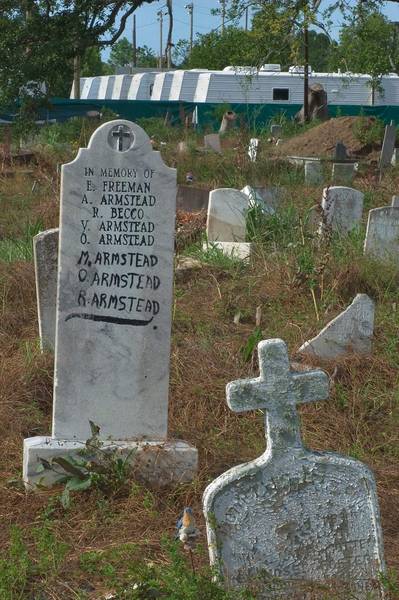

A tomb of E. Freeman, A. Armstead, R. Becco, and Armsteads, with temporary housing (FEMA trailers) in background, in Holt Cemetery. New Orleans, Louisiana


Album 521: Cemeteries and French Quarter in New Orleans LA, April 30 - May 6, 2006
The image depicts a grave marker surrounded by other headstones, set against the backdrop of temporary housing units.
**Grave Marker:**
The primary focus is on the central grave marker, which is tall and narrow with an arched top. The stone has weathered to a light gray color, giving it a worn appearance. A cross adorns the top arch, adding a touch of elegance to the overall design. At the top of the marker, there are four names listed in capital letters: "E. FREEMAN", "A. ARMSTEAD", "R. BECCO", and "M., O., & R. ARMSTEADS". The text is written in black paint, creating a striking contrast against the light gray background.
**Surrounding Headstones:**
Several other headstones are visible around the central marker, although they appear smaller and less prominent than the main one. These headstones are also made of stone but lack the distinctive arched top of the primary grave marker.
**Temporary Housing (FEMA Trailers):**
In the background, several temporary housing units can be seen. These trailers are likely part of a larger effort to provide accommodation for those affected by a disaster or other crisis. The presence of these trailers suggests that the area may have been impacted by some kind of emergency situation, such as Hurricane Katrina.
**Holt Cemetery:**
The image is set within Holt Cemetery in New Orleans, Louisiana. This cemetery appears to be an older establishment, given the style and design of the headstones. The fact that it is located near temporary housing units implies that the area has been affected by some kind of disaster or emergency situation.
**Date and Context:**
The image was taken on April 30, 2006. Considering this date and the presence of temporary housing units in the background, it is likely that the area was impacted by Hurricane Katrina, which devastated New Orleans in August 2005. The image provides a poignant reminder of the devastating effects of natural disasters on communities and individuals.
In summary, the image captures a grave marker surrounded by other headstones within Holt Cemetery, with temporary housing units visible in the background. The date and context suggest that the area was affected by Hurricane Katrina, highlighting the importance of preserving historical sites and providing support to those affected by such events. – AI vision
🇫🇷 Description en français / French Description
Voici une traduction du texte de l'anglais au français :
Une tombe d'E. Freeman, A. Armstead, R. Becco et des Armsteads, avec des logements provisoires (des roulottes FEMA) en arrière-plan, dans le cimetière Holt. La Nouvelle-Orléans, Louisiane, 30 avril 2006. L'image montre une pierre tombale entourée d'autres pierres tombales, avec en arrière-plan des logements provisoires. **Pierre tombale** : l'élément central de la tombe est une pierre tombale haute et étroite dotée d'un dessus en arc. La pierre a pris une couleur grise claire, lui donnant un aspect usé. Une croix orne le dessus de l'arc, ajoutant une touche d'élégance à la conception générale. En haut de la pierre tombale, les noms des quatre personnes sont écrits en lettres capitales : "E. FREEMAN", "A. ARMSTEAD", "R. BECCO" et "M., O., & R. ARMSTEADS". Le texte est peint en noir, créant un contraste frappant sur le fond gris clair. **Pierres tombales avoisinantes** : plusieurs autres pierres tombales sont visibles autour de la tombe centrale, mais elles paraissent plus petites et moins importantes que celle-ci. Ces pierres tombales sont également faites en pierre, mais manquent du dessus en arc caractéristique de la tombe principale. **Logements provisoires (roulottes FEMA) :** des logements provisoires sont visibles en arrière-plan. Il s'agit vraisemblablement d'un effort plus important pour fournir un hébergement aux personnes affectées par une catastrophe ou autre situation de crise. La présence de ces logements suggère que la région a été touchée par une situation d'urgence, comme l'ouragan Katrina. **Cimetière Holt** : L'image est prise dans le cimetière Holt à La Nouvelle-Orléans, en Louisiane. Ce cimetière semble être un établissement ancien, vu le style et la conception des pierres tombales. Le fait qu'il se situe près de logements provisoires implique que la région a été affectée par une catastrophe ou situation d'urgence. **Date et contexte** : La photo a été prise le 30 avril 2006. Compte tenu de cette date et des logements provisoires en arrière-plan, il est probable que la région ait été touchée par l'ouragan Katrina qui a ravagé la Nouvelle-Orléans en août 2005. L'image constitue un rappel poignant des effets dévastateurs des catastrophes naturelles sur les communautés et les individus. En résumé, l'image capture une pierre tombale entourée d'autres pierres tombales dans le cimetière Holt avec des logements provisoires visibles en arrière-plan. La date et le contexte suggèrent que la région a été affectée par l'ouragan Katrina, soulignant l'importance de préserver les sites historiques et d'apporter un soutien aux personnes touchées par de tels événements. – French translation


