
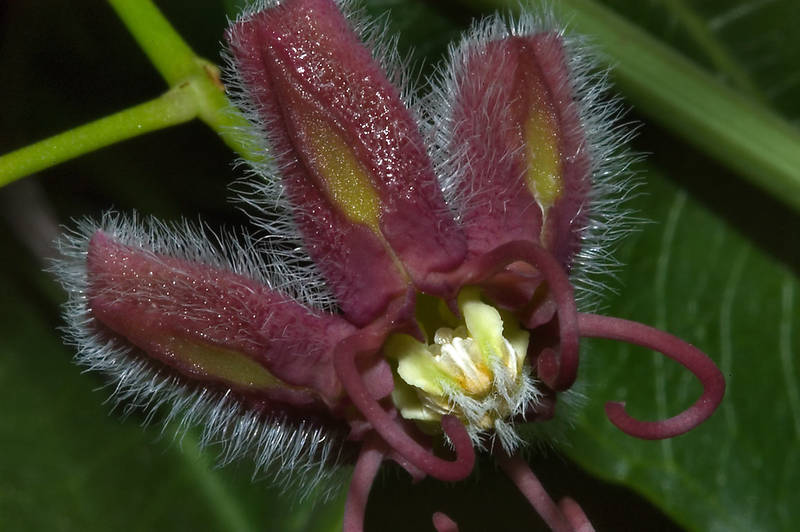

Silk vine (Periploca graeca) in TAMU Holistic Garden in Texas A&M University. College Station, Texas


Album 632: Flowers in College Station, Texas, April 14 - 18, 2008
The image presents a close-up view of a silk vine (Periploca graeca) flower in bloom. The flower is situated at the center of the frame, with its petals and stamen visible.
* **Flower Color**:
* The flower features a deep red coloration, primarily due to the presence of anthocyanins.
* This pigment contributes to the flower's vibrant appearance.
* **Petals**:
* The petals are shaped like trumpets and exhibit long hairs along their edges.
* They have a waxy texture, which may aid in water conservation or provide additional structural support.
* **Stamen**:
* The stamens are yellow in color and appear to be arranged in a spiral pattern within the flower's center.
* This arrangement is typical for many plant species, facilitating pollination by attracting insects such as bees and butterflies.
* **Background**:
* The background of the image is not visible due to the proximity of the camera to the flower.
* However, it can be inferred that the flower is part of a larger plant or garden setting.
In summary, the image showcases a silk vine flower with distinctive features such as its deep red color, long-haired petals, and yellow stamens arranged in a spiral pattern. These characteristics are likely adaptations for attracting pollinators and ensuring successful reproduction. – AI vision
🇪🇸 Descripción en español / Spanish Description
La flor de la vite de seda (Periploca graeca) en el Jardín Holístico TAMU en Texas A&M University. College Station, Texas, 16 de abril de 2008. La imagen presenta una vista detallada de una flor de vite de seda (Periploca graeca) en floración. La flor se encuentra en el centro del fotograma, con sus pétalos y su antera visibles. **Color de la flor**: * La flor tiene una coloración roja oscura, principalmente debido a la presencia de antocianinas. * Este pigmento contribuye al vibrante aspecto de la flor. **Pétalos**: * Los pétalos tienen forma de trompeta y presentan largos pelos a lo largo de sus bordes. * Tienen una textura cérea, que puede ayudar en la conservación del agua o proporcionar un soporte estructural adicional. **Stamen**: * Los stamen son de color amarillo y parecen estar dispuestos en forma espiral dentro del centro de la flor. * Esta disposición es típica para muchas especies de plantas, lo que facilita la polinización al atraer insectos como abejas y mariposas. **Antecedentes**: * El fondo de la imagen no es visible debido a la proximidad de la cámara con respecto a la flor. * Sin embargo, se puede deducir que la flor forma parte de un entorno más grande o jardín. En resumen, la imagen muestra una flor de vite de seda con características distintivas como su coloración roja oscura, sus pétalos largamente peludos y sus stamen amarillos dispuestos en forma espiral. Estas características son probablemente adaptaciones para atraer polinizadores y asegurar una reproducción exitosa. – Spanish translation


