
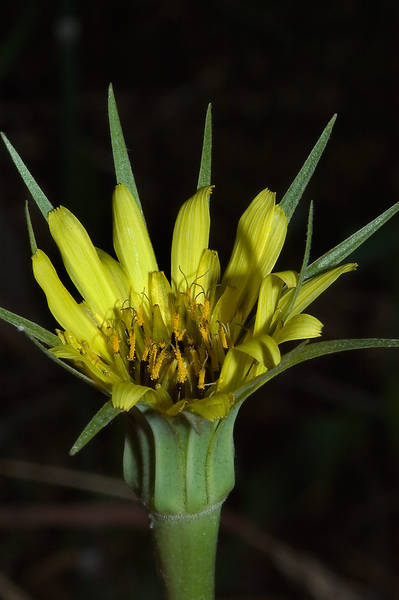

Yellow salsify (goat's beard, Tragopogon dubius) flower in Capulin Canyon in Bandelier National Monument. New Mexico, near Los Alamos


Album 645: College Station TX - Bandelier Monument NM, May 18 - 24, 2008
The photograph showcases a vibrant yellow flower with long, thin petals and green leaves, likely belonging to the species Tragopogon dubius (yellow salsify) or another member of the same genus.
**Key Features:**
* **Flower Structure:** The flower has 9-15 petals arranged in a spiral pattern around its center. This is consistent with other members of the genus, which can have anywhere from 7 to 21 petals.
* **Center:** The yellow stamens are visible at the center of the flower, adding to its bright appearance.
* **Leaves:** The green leaves surrounding the flower are long and thin, tapering off towards their tips. They resemble grass blades or a type of fern frond.
**Background:**
The background is dark and blurry, suggesting that the photograph was taken in a forest setting. This is consistent with the location mentioned in the caption, as Bandelier National Monument is known for its forests and canyons.
**Overall Impression:**
The image presents a close-up view of a beautiful yellow flower, likely growing wild in a natural environment. The bright coloration and delicate structure of the petals make it an attractive subject for photography or botanical studies. – AI vision
🇪🇸 Descripción en español / Spanish Description
La flor de hinojo amarillo (barba de cabra, Tragopogon dubius) en el Cañón Capulín del Monumento Nacional Bandelier. Nuevo México, cerca de Los Alamos, el 24 de mayo de 2008. La fotografía muestra una flor amarilla vibrante con pétalos finos y largos y hojas verdes, probablemente pertenecientes a la especie Tragopogon dubius (hinojo amarillo) u otro miembro del mismo género. **Características clave:** * **Estructura de las flores:** La flor tiene 9-15 pétalos dispuestos en un patrón en espiral alrededor de su centro. Esto es consistente con otros miembros del género, que pueden tener de 7 a 21 pétalos. * **Centro:** Los estambres amarillos son visibles en el centro de la flor, lo que agrega a su apariencia brillante. * **Hojas:** Las hojas verdes que rodean la flor son largas y finas, estrechándose hacia sus puntas. Se asemejan a hojas de hierba o un tipo de hoja de helecho. **Antecedentes:** El fondo es oscuro y borroso, lo que sugiere que la fotografía se tomó en un entorno forestal. Esto es consistente con el lugar mencionado en el pie de foto, ya que el Monumento Nacional Bandelier es conocido por sus bosques y cañones. **Impresión general:** La imagen presenta una vista cercana de una hermosa flor amarilla, probablemente creciendo silvestre en un entorno natural. La coloración brillante y la estructura delicada de los pétalos la convierte en un sujeto atractivo para la fotografía o estudios botánicos. – Spanish translation


