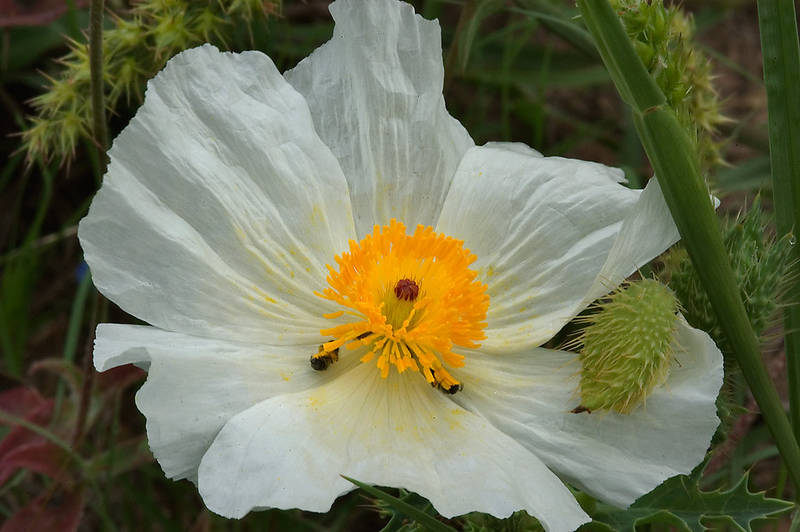

White prickly poppy in Washington-on-the-Brazos State Historic Site. Washington, Texas


Album 663: College Station - Washington-on-the-Brazos, Texas, August 3 - 9, 2008
The image presents a close-up view of a white prickly poppy flower, showcasing its intricate details. The flower's petals are white and slightly ruffled, with a subtle sheen that suggests they may be slightly damp or dewy. At the center of the flower, two small black bees can be seen collecting pollen, their bodies partially obscured by the yellow stamens.
In the background, several other prickly poppy flowers are visible, although they are not as prominent as the main subject. The surrounding foliage appears to be a mix of green and reddish-brown hues, adding depth and texture to the image.
The overall atmosphere of the photograph is one of serenity and natural beauty, with the delicate white petals and vibrant yellow stamens creating a sense of harmony and balance. The presence of the bees adds a touch of dynamism to the scene, highlighting the importance of these tiny creatures in pollination.
The image also provides valuable information about the prickly poppy plant itself. According to the provided caption, this particular species is known as Argemone albiflora, which translates to "white-flowered argemone" in Latin. This suggests that the flower's white coloration is a distinguishing feature of this specific variety.
Furthermore, the image offers insight into the location where the photograph was taken. Washington-on-the-Brazos State Historic Site is a state park located in Texas, USA, which implies that the prickly poppy plant is native to or commonly found in this region. This information can be useful for botanists, researchers, and enthusiasts interested in learning more about the distribution and habitats of various plant species.
In conclusion, the image presents a stunning close-up view of a white prickly poppy flower, showcasing its intricate details and natural beauty. The photograph provides valuable information about the plant's characteristics, location, and ecological importance, making it a useful resource for those interested in botany and nature photography. – AI vision
🇪🇸 Descripción en español / Spanish Description
El amapola espinoso blanco en el sitio histórico estatal de Washington-on-the-Brazos. Washington, Texas, 9 de agosto de 2008. La imagen presenta una vista cercana de una flor de amapola espinoso blanca, mostrando sus detalles intrincados. Las pétalas de la flor son blancas y ligeramente rizadas, con un brillo sutil que sugiere que pueden estar ligeramente húmedas o rocía. En el centro de la flor, se puede ver a dos pequeñas abejas recogiendo polen, sus cuerpos parcialmente ocultos por los estambres amarillos. En segundo plano, son visibles varias otras flores de amapola espinoso, aunque no son tan prominentes como el tema principal. El follaje circundante parece ser una mezcla de tonos verde y marrón rojizo, agregando profundidad y textura a la imagen. La atmósfera general de la fotografía es de serenidad y belleza natural, con las delicadas pétalas blancas y los vibrantes estambres amarillos creando una sensación de armonía y equilibrio. La presencia de las abejas agrega un toque de dinamismo a la escena, destacando la importancia de estas pequeñas criaturas en la polinización. La imagen también proporciona información valiosa sobre la planta del amapola espinoso en sí. De acuerdo con la leyenda proporcionada, esta especie en particular se conoce como Argemone albiflora, que significa "argemona de flores blancas" en latín. Esto sugiere que la coloración blanca de la flor es una característica distintiva de esta variedad específica. Además, la imagen ofrece información sobre el lugar donde se tomó la fotografía. El sitio histórico estatal de Washington-on-the-Brazos es un parque estatal ubicado en Texas, EE. UU., lo que sugiere que la planta del amapola espinoso es nativa o se encuentra comúnmente en esta región. Esta información puede ser útil para los biólogos, investigadores y entusiastas interesados en aprender más sobre la distribución y hábitats de varias especies de plantas. En conclusión, la imagen presenta una impresionante vista cercana de un amapola espinoso blanco, mostrando sus detalles intrincados y su belleza natural. La fotografía proporciona información valiosa sobre las características de la planta, el lugar y su importancia ecológica, convirtiéndola en un recurso útil para aquellos interesados en botánica y fotografía de naturaleza. – Spanish translation