
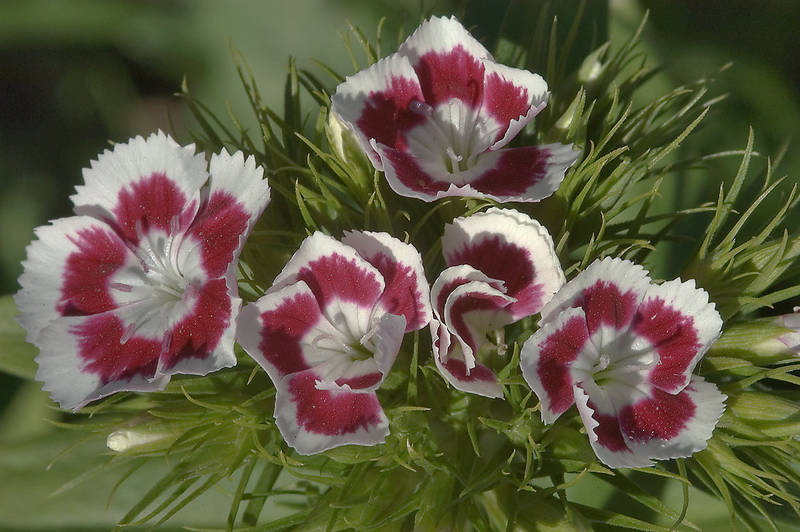

Dianthus flowers in TAMU Holistic Garden in Texas A&M University. College Station, Texas


Album 701: College Station - La Grange, Texas, January 15 - 19, 2009
The image depicts a cluster of five pink and white Dianthus flowers in bloom on a green stem. The background is blurred and appears to be various shades of green.
Dianthus flowers are also known as carnations or sweet williams and they come in many colors, including pink, red, purple, blue, yellow, orange, white, and bi-colored. They are native to Europe, Asia, and Africa but are now grown worldwide.
The flowers have five petals with the outer two being larger than the inner three. They also have a distinctive shape, with the petals curving backwards towards the center of the flower.
Dianthus plants are typically low-growing perennials that can be found growing in fields, meadows, and along roadsides. They prefer well-drained soil and full sun to partial shade.
The flowers attract bees and other pollinators, which helps them reproduce by producing seeds. The seeds are contained within the fruit of the plant, known as a capsule or follicle.
In addition to their beauty, Dianthus plants have several medicinal uses. They contain flavonoids and phenolic acids that have anti-inflammatory properties and can be used to treat various ailments such as arthritis, fever, and digestive issues.
Overall, Dianthus flowers are not only visually appealing but also possess numerous benefits for both humans and the environment. – AI vision
🇪🇸 Descripción en español / Spanish Description
Las flores de Dianthus en el jardín holístico TAMU en Texas A&M University. College Station, Texas, 18 de enero de 2009. La imagen representa un grupo de cinco flores rosa y blancas de Dianthus florecientes en un tallo verde. El fondo está borroso y parece tener diferentes tonos de verde. Las flores de Dianthus también se conocen como claveles o violetas europeas y vienen en muchos colores, incluyendo rosa, rojo, morado, azul, amarillo, naranja, blanco y dos colores. Son nativas de Europa, Asia y África, pero ahora se cultivan en todo el mundo. Las flores tienen cinco pétalos, siendo los exteriores mayores que los interiores. También tienen una forma distintiva, con los pétalos curvándose hacia atrás hacia el centro de la flor. Las plantas de Dianthus son perennes de crecimiento bajo que pueden encontrarse en campos, praderas y a lo largo de carreteras. Prefieren suelo bien drenado y sol completo a sombra parcial. Las flores atraen abejas y otros polinizadores, lo que les ayuda a reproducirse produciendo semillas. Los frutos contienen las semillas y se conocen como cápsulas o folículos. Además de su belleza, las plantas de Dianthus tienen varios usos medicinales. Contienen flavonoides y ácidos fenólicos que tienen propiedades antiinflamatorias y se pueden usar para tratar diversas afecciones como artritis, fiebre y problemas digestivos. En general, las flores de Dianthus no solo son visualmente atractivas sino que también poseen numerosos beneficios tanto para seres humanos como para el medio ambiente. – Spanish translation


