
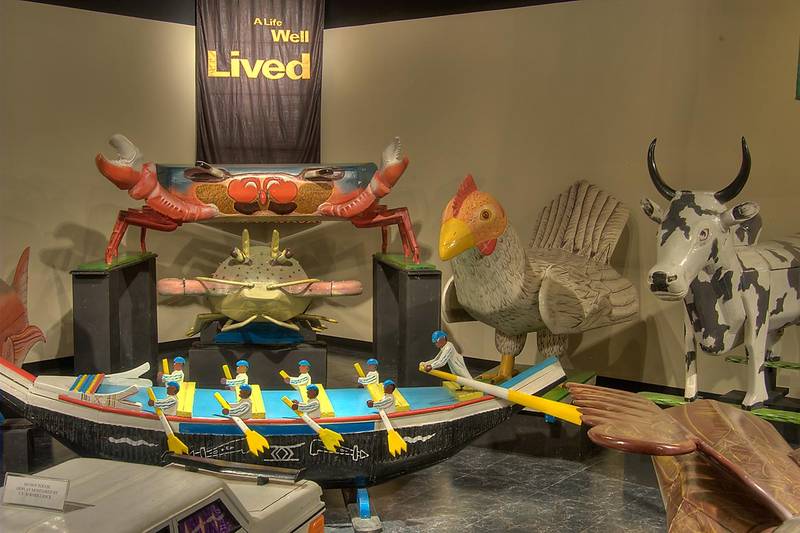

Brightly colored wooden coffins from Ghana carved as objects capturing essence of the departed (fishing canoe, chicken, bull, crab etc.) in National Museum of Funeral History. Houston, Texas


Album 710: Houston - College Station, Texas, February 8 - 12, 2009
The image showcases a vibrant and eclectic display of intricately carved wooden coffins from Ghana at the National Museum of Funeral History in Houston, Texas. The coffins are not only functional but also serve as artistic expressions that capture the essence of the deceased.
At the center of the image is a brightly colored fishing canoe coffin, its hull adorned with intricate carvings. Behind it stands a large wooden crab coffin, while to the left sits a chicken-shaped coffin. On the floor in front of these coffins lies a bull-shaped coffin, adding to the colorful array of funerary art.
The National Museum of Funeral History is dedicated to preserving and showcasing the history and culture surrounding death and dying. It offers visitors an opportunity to explore various aspects of funeral practices from around the world, providing insight into the unique customs and traditions that shape how people mourn and honor their loved ones.
In this image, the museum's collection of Ghanaian coffins serves as a testament to the creativity and cultural significance attached to these objects. The coffins are not just mere containers for the deceased but also works of art that reflect the values and beliefs of the communities they originate from. By preserving and displaying such artifacts, the National Museum of Funeral History aims to educate visitors about the diverse ways in which people approach death and the afterlife.
Overall, the image presents a fascinating glimpse into the world of funerary culture, highlighting the importance of understanding and respecting the customs and traditions that shape how we grieve and remember those who have passed away. – AI vision
🇪🇸 Descripción en español / Spanish Description
Los ataúdes de madera de colores brillantes tallados en Gana capturan los objetos esenciales del fallecido (canoa pesquera, pollo, toro, cangrejo, etc.) en el Museo Nacional de la Historia Funeraria. Houston, Texas, 8 de febrero de 2009. La imagen presenta una exhibición vibrante y ecléctica de ataúdes de madera tallada con muchos detalles desde Gana en el Museo Nacional de la Historia Funeraria en Houston, Texas. Los ataúdes no solo son funcionales sino que también sirven como expresiones artísticas que capturan la esencia del fallecido. En el centro de la imagen se encuentra un ataúd con forma de canoa para pescar, brillantemente decorado con grabados complejos. Detrás de él se erige un gran ataúd de madera en forma de cangrejo, mientras que a su izquierda se sienta un ataúd con forma de pollo. En el suelo delante de estos ataúdes yace un ataúd en forma de toro, sumándose a la variopinta exposición de arte funerario. El Museo Nacional de la Historia Funeraria se dedica a preservar y exhibir la historia y la cultura que rodean a la muerte y la despedida. Ofrece a los visitantes la oportunidad de explorar diversos aspectos de las prácticas funerarias de todo el mundo, proporcionando información sobre los hábitos y tradiciones únicos que conforman la forma en que la gente duela y honra a sus seres queridos. En esta imagen, la colección del museo de ataúdes de Gana es una muestra de la creatividad y el significado cultural adjuntados a estos objetos. Los ataúdes no son solo simples recipientes para el fallecido sino también obras de arte que reflejan los valores y creencias de las comunidades de donde provienen. Al preservar y exponer tales artefactos, el Museo Nacional de la Historia Funeraria pretende educar a los visitantes sobre las diversas maneras en que las personas abordan la muerte y la vida después de la muerte. En general, la imagen ofrece una fascinante mirada al mundo de la cultura funeraria, resaltando la importancia de comprender y respetar los hábitos y tradiciones que conforman la forma en que lloramos y recordamos a las personas fallecidas. – Spanish translation


