
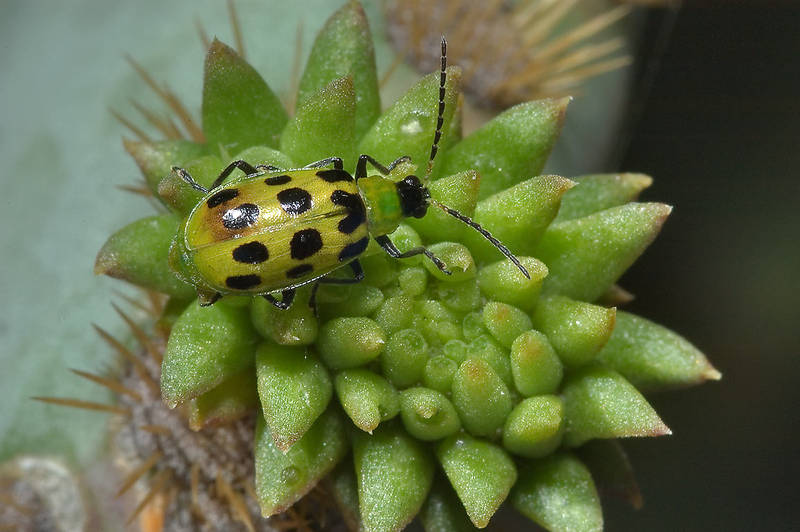

Spotted cucumber beetle (Diabrotica undecimpunctata) on a shoot of prickly pears cactus in Ladybird Johnson Wildflower Center. Austin, Texas


Album 717: Gardens in Austin and College Station, Texas, March 7 - 8, 2009
The image shows a close-up photograph of an insect, specifically a spotted cucumber beetle (Diabrotica undecimpunctata), perched on a green shoot of prickly pears cactus.
**Insect Description**
* The beetle is yellow with black spots and has six legs.
* Its body is elongated and oval-shaped.
* It features two long antennae protruding from its head, which are thin and tapered at the end.
* The beetle's legs appear to be in motion, as if it is about to jump or move.
**Cactus Description**
* The cactus shoot is green and spiny, with many short, sharp thorns covering its surface.
* The plant appears to be a type of prickly pear cactus (Opuntia spp.), which is native to the Americas.
* The cactus has a thick, fleshy stem that is covered in small, rounded areoles (the small circular areas from which spines emerge).
* The areoles are densely packed and give the plant a characteristic appearance.
**Background**
* The background of the image is out of focus but appears to be a natural environment, possibly a garden or a field.
* There are no other insects or objects visible in the background that could distract from the main subject of the image: the spotted cucumber beetle on the prickly pears cactus.
Overall, the image provides a detailed view of an insect and its habitat, showcasing the unique characteristics of both the beetle and the cactus. – AI vision
🇪🇸 Descripción en español / Spanish Description
El escarabajo de la papa (Diabrotica undecimpunctata) en una yema del cactus de los tuna en el Centro de Flores Silvestres Ladybird Johnson. Austin, Texas, 7 de marzo de 2009. La imagen muestra una fotografía en primer plano de un insecto, específicamente un escarabajo de la papa de manchas negras (Diabrotica undecimpunctata), posado en un tallo verde del cactus de los tuna. **Descripción del insecto** * El escarabajo es amarillo con manchas negras y tiene seis patas. * Su cuerpo es alargado y de forma ovalada. * Presenta dos largos antenas que sobresalen de su cabeza, que son finas y estrechas en el extremo. * Las patas del escarabajo parecen estar en movimiento, como si estuviera a punto de saltar o moverse. **Descripción del cactus** * El brote del cactus es verde y espinoso, con muchas espinas cortas y agudas que cubren su superficie. * El cactus parece ser un tipo de cactus del tuna (Opuntia spp.), que es nativo de las Américas. * El cactus tiene un tallo grueso y carnoso que está cubierto de pequeñas areolas redondas (las pequeñas áreas circulares desde las cuales emergen las espinas). * Las areolas están densamente empaquetadas y le dan al planta un aspecto característico. **Antecedentes** * El fondo de la imagen está desenfocado, pero parece ser un entorno natural, posiblemente un jardín o un campo. * No hay otros insectos u objetos visibles en el fondo que puedan distraer del tema principal de la imagen: el escarabajo de manchas negras sobre el cactus del tuna. En general, la imagen proporciona una vista detallada de un insecto y su hábitat, mostrando las características únicas tanto del escarabajo como del cactus. – Spanish translation


