
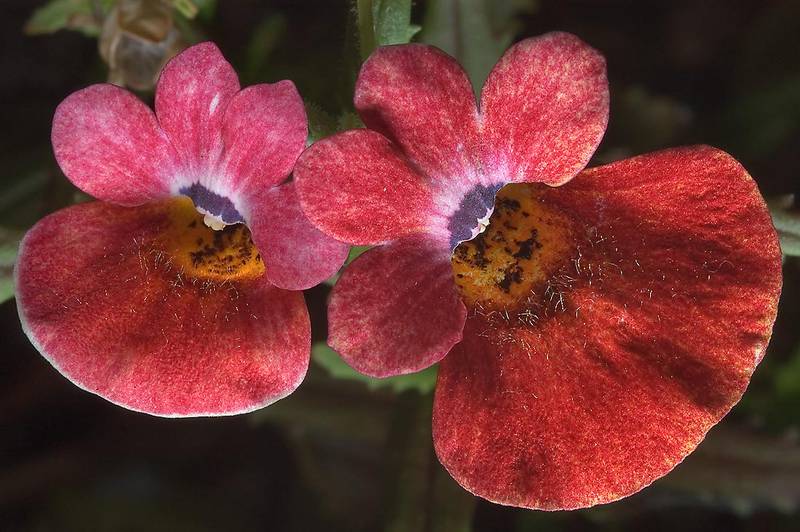

Nemesia flowers in TAMU Horticultural Gardens in Texas A&M University. College Station, Texas


Album 745: College Station - Washington-on-the-Brazos, Texas, May 8 - 9, 2009
The image presents a close-up view of three vibrant red flowers with yellow centers, showcasing their delicate petals and intricate details. The flowers are likely from the Nemesia genus, commonly known as Cape primrose or baby's breath, which is native to South Africa.
**Key Features:**
* **Flowers:** Three red flowers with yellow centers, featuring five-petaled blooms.
* **Coloration:** Red petals and yellow center, with a subtle gradient effect on the petals.
* **Background:** Dark green leaves provide a striking contrast to the bright flowers.
* **Lighting:** The image is illuminated by natural light, highlighting the intricate details of the flowers.
**Composition:**
* **Subject:** The primary subject of the image is the Nemesia flower, with the three blooms arranged in a harmonious composition.
* **Symmetry:** The arrangement of the flowers creates a sense of symmetry, drawing the viewer's attention to the center of the image.
* **Depth of Field:** A shallow depth of field blurs the background, emphasizing the flowers and creating a sense of intimacy.
**Overall:**
The image showcases the beauty and intricacy of the Nemesia flower, highlighting its unique characteristics and vibrant colors. The composition and lighting work together to create a visually appealing and engaging photograph that invites the viewer to appreciate the details of this lovely bloom. – AI vision
🇪🇸 Descripción en español / Spanish Description
Las flores de Nemesia en los Jardines Hortícolas TAMU en Texas A&M University, College Station, Texas, 8 de mayo de 2009. La imagen muestra una vista de cerca de tres flores rojas con centros amarillos, que muestran sus pétalos delicados y detalles complejos. Las flores son probablemente del género Nemesia, comúnmente conocida como primavera del Cabo o respiración de bebé, nativa de Sudáfrica. **Características clave:** * **Flores:** Tres flores rojas con centros amarillos, que presentan pétalos de cinco hojas. * **Coloración:** Pétalos rojos y centro amarillo, con un efecto gradiente sutil en los pétalos. * **Fondo:** Hojas verdes oscuras que proporcionan un contraste sorprendente con las flores brillantes. * **Iluminación:** La imagen está iluminada por luz natural, lo que destaca los detalles complejos de las flores. **Composición:** * **Sujeto:** El sujeto principal de la imagen es la flor de Nemesia, con tres flores dispuestas en una composición armoniosa. * **Simetría:** La disposición de las flores crea una sensación de simetría, lo que atrae la atención del espectador al centro de la imagen. * **Profundidad de campo:** Una profundidad de campo corta borra el fondo, enfatizando las flores y creando una sensación de intimidad. **En general:** La imagen muestra la belleza e intrincación de la flor de Nemesia, destacando sus características únicas y colores vibrantes. La composición y la iluminación trabajan juntos para crear una fotografía atractiva visualmente que invita al espectador a apreciar los detalles de esta hermosa flor. – Spanish translation


