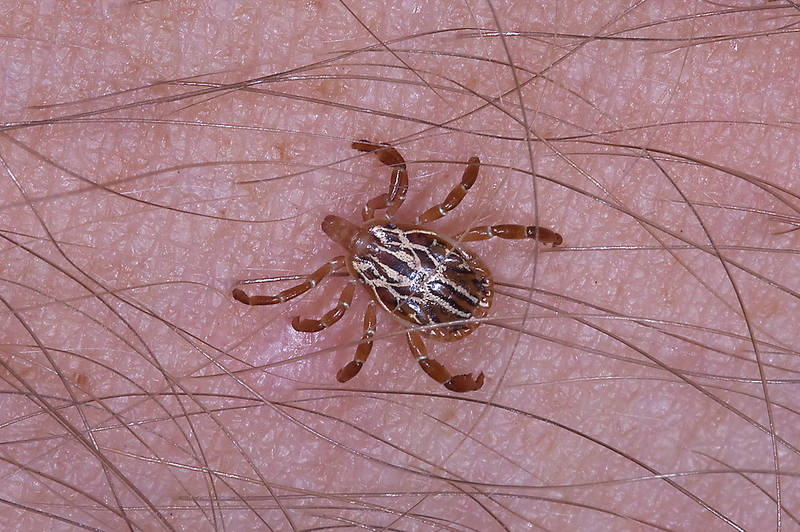

Gulf Coast Tick (Amblyomma maculatum) on human skin on an island in Lake Bryan Park. Bryan, Texas


Album 795: College Station - Mercer Arboretum, Texas, September 27 - October 3, 2009
The image depicts a close-up view of a tick embedded in human skin, with the tick's body situated in the upper middle section of the frame.
**Tick Characteristics**
* The tick is brown and oval-shaped.
* It has eight legs that are slightly curved and appear to be moving towards the top-right corner of the image.
* Its mouthparts are visible, indicating it is feeding on human blood.
* The tick's body is covered in fine hairs or setae.
**Skin Surrounding the Tick**
* The skin surrounding the tick appears pinkish-beige with a slightly textured surface.
* There are several small hairs scattered around the area where the tick is embedded.
* The skin does not appear to be inflamed or irritated, suggesting that the tick has only recently attached itself to the host.
**Overall Impression**
The image provides a detailed view of the tick's anatomy and its interaction with human skin. It highlights the importance of proper identification and removal techniques for ticks, as they can transmit diseases such as Lyme disease and Rocky Mountain spotted fever. – AI vision
🇪🇸 Descripción en español / Spanish Description
La garrapata de la Costa del Golfo (Amblyomma maculatum) en la piel humana en una isla del Parque Bryan Lake. Bryan, Texas, el 2 de octubre de 2009. La imagen representa una vista detallada de una garrapata incrustada en la piel humana, con el cuerpo de la garrapata situado en la sección media superior del marco. **Características de la garrapata** *La garrapata es de color marrón y tiene forma ovalada.* Tiene ocho patas que están ligeramente curvadas y parecen moverse hacia la esquina superior derecha de la imagen.* Sus órganos bucales son visibles, lo que indica que se está alimentando de sangre humana. *El cuerpo de la garrapata está cubierto de pelos finos o setae.**Piel que rodea a la garrapata*La piel que rodea a la garrapata parece ser rosada-beige, con una superficie ligeramente estructurada. *Hay varios pelitos dispersos por toda la zona donde está incrustada la garrapata.*La piel no parece inflamada o irritada, lo que sugiere que la garrapata se ha pegado recientemente al huésped.**Impresión general**La imagen proporciona una vista detallada de la anatomía de la garrapata y su interacción con la piel humana. Destaca la importancia de las técnicas adecuadas de identificación y retirada de garrapatas, ya que pueden transmitir enfermedades como la enfermedad de Lyme y la fiebre maculosa de las montañas rocosas. – Spanish translation