
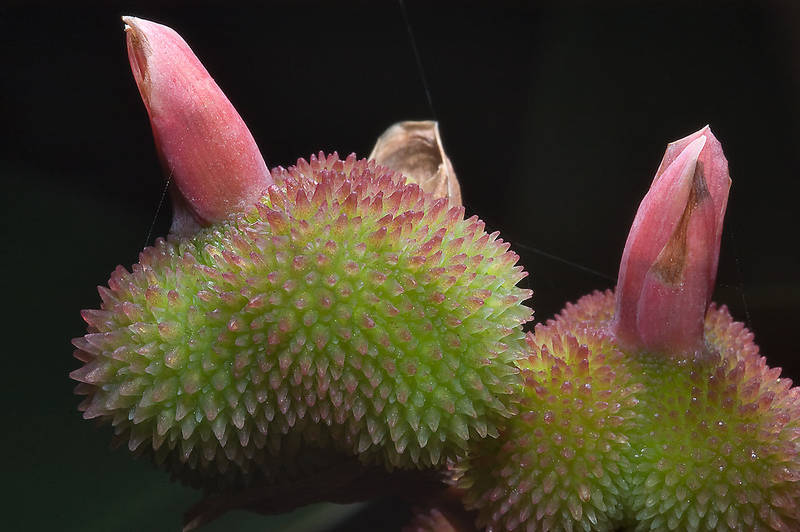
Fruits of canna in TAMU Holistic Garden in Texas A&M University. College Station, Texas


Album 805: College Station - Independence, Texas, November 8, 2009
The image showcases three fruits of a Canna plant, specifically known as "Canna x generalis." The fruits are depicted from two different angles: one at the top and another positioned slightly below it, with its stem facing toward the left side of the frame.
**Color Scheme**
* **Fruits**: The fruits appear to be light green with pink tips.
* **Background**: The background is black, providing a striking contrast to the vibrant colors of the fruits.
**Composition**
The image features three distinct compositions:
1. **Central Composition**: A single fruit dominates the center of the frame, showcasing its unique shape and coloration.
2. **Top-Right Corner Composition**: In the top-right corner, another fruit is partially visible, adding depth to the composition.
3. **Bottom-Left Corner Composition**: The third fruit is positioned in the bottom-left corner, creating a sense of balance and harmony.
**Overall Impression**
The image exudes a sense of freshness and vitality, thanks to the bright colors and dynamic composition. The use of black as the background helps to accentuate the vibrant hues of the fruits, making them stand out even more. Overall, the image effectively captures the beauty and uniqueness of the Canna plant's fruit. – AI vision
🇪🇸 Descripción en español / Spanish Description
Frutos de cana en el Jardín Holístico TAMU en la Universidad Texas A&M. College Station, Texas, 8 de noviembre de 2009. La imagen muestra tres frutos de una planta de cana, específicamente conocida como "Canna x generalis". Los frutos se representan desde dos ángulos diferentes: uno en la parte superior y otro colocado ligeramente debajo, con su tallo orientado hacia el lado izquierdo del marco. **Esquema de color** * **Frutos**: los frutos parecen ser de un verde claro con puntas rosadas. * **Fondo**: el fondo es negro, lo que proporciona un contraste sorprendente con los colores vibrantes de los frutos. **Composición** La imagen presenta tres composiciones distintas: 1. **Composición central**: en el centro del marco predomina un solo fruto, mostrando su forma y coloración únicas. 2. **Composición superior derecha**: en la esquina superior derecha, otro fruto está parcialmente visible, lo que agrega profundidad a la composición. 3. **Composición inferior izquierda**: el tercer fruto se coloca en la esquina inferior izquierda, creando una sensación de equilibrio y armonía. **Impresión general** La imagen transmite un sentimiento de frescura y vitalidad gracias a los colores brillantes y la composición dinámica. El uso del negro como fondo ayuda a acentuar las tonalidades vibrantes de los frutos, haciéndolos destacar aún más. En general, la imagen capta efectivamente la belleza y singularidad de los frutos de la planta de cana. – Spanish translation


