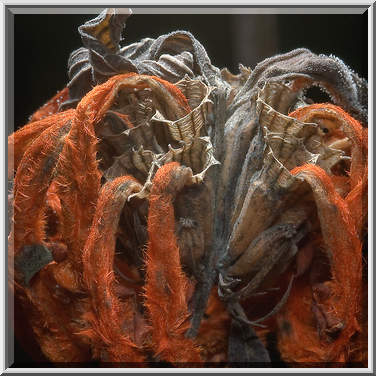
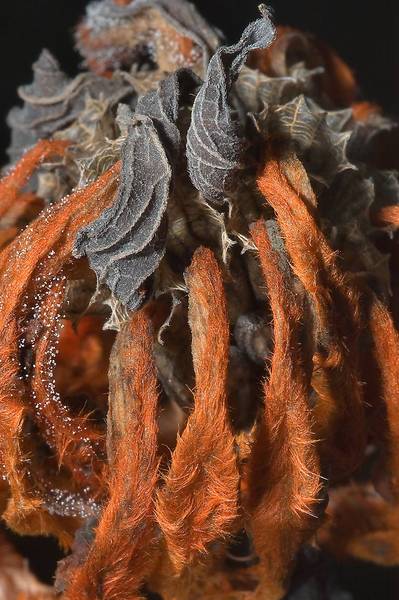

Dry orange flowers of leonotis in TAMU Horticultural Gardens in Texas A&M University. College Station, Texas


Album 816: College Station - Houston, Texas, December 16 - 23, 2009
The image presents a close-up view of dry orange flowers belonging to the Leonotis species, situated within the TAMU Horticultural Gardens at Texas A&M University in College Station, Texas. The photograph was captured on December 16, 2009.
**Overall Appearance**
* The flowers are characterized by their dry and desiccated state.
* Their once-vibrant orange hue has faded to a duller shade, indicating the passage of time since they were last watered or exposed to moisture.
**Coloration**
* The primary color of the flowers is a muted orange tone, which has become increasingly subdued due to drying out.
* The petals and sepals exhibit a subtle gradient effect, transitioning from darker tones towards their bases to lighter shades closer to their tips.
**Texture and Form**
* Upon closer inspection, it becomes apparent that the flowers have undergone significant desiccation.
* Their once-soft texture has transformed into a brittle, papery consistency, with visible cracks and fissures throughout the petals and sepals.
* The arrangement of the flowers on the stem appears somewhat disheveled, suggesting that they may have been partially disturbed or damaged during the drying process.
**Background**
* Against a stark black background, the dried flowers stand out prominently, drawing attention to their unique texture and coloration.
* The absence of any surrounding foliage or other elements allows for an unobstructed view of the flowers themselves. – AI vision
🇪🇸 Descripción en español / Spanish Description
Las flores secas de naranja leonotis en los Jardines Hortícolas TAMU en la Universidad Texas A&M. College Station, Texas, 16 de diciembre de 2009. La imagen presenta una vista detallada de las flores secas de color naranja pertenecientes a la especie leonotis, ubicadas dentro de los Jardines Hortícolas TAMU en la Universidad Texas A&M en College Station, Texas. La fotografía fue capturada el 16 de diciembre de 2009. **Apariencia General** * Las flores se caracterizan por su estado seco y desecado. * Su tono naranja vibrante ha desaparecido para dar paso a un tono más tenue, lo que indica el transcurso del tiempo desde la última vez que fueron regadas o expuestas a la humedad. **Coloración** * El color principal de las flores es un tono naranja atenuado, que se ha vuelto cada vez más moderado debido al secado. * Los pétalos y los sépalos exhiben un efecto gradiente sutil, pasando de tonos más oscuros hacia sus bases a tonos más claros hacia las puntas. **Textura y Forma** * Al inspeccionar detalladamente, se aprecia que las flores han sufrido una desecación considerable. * Su textura blanda inicial ha cambiado a una consistencia áspera y papelosa, con grietas visibles en los pétalos y sépalos. * La disposición de las flores sobre el tallo parece algo desordenada, sugiriendo que pudieron haber sido parcialmente perturbadas o dañadas durante el proceso de secado. **Antecedentes** * Frente a un fondo negro uniforme, las flores secas sobresalen de manera prominente, atraen la atención hacia su textura y color únicos. * La ausencia de cualquier foliaje circundante u otros elementos permite una visión sin obstáculos de las flores en sí mismas. – Spanish translation


