
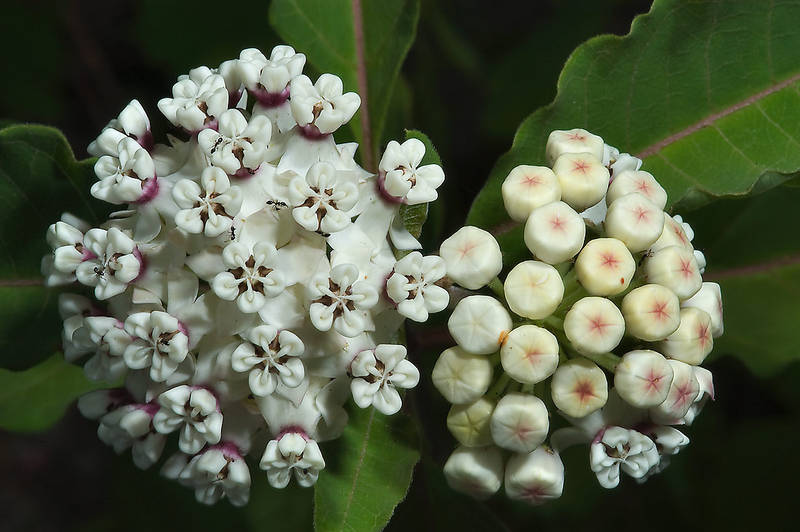
Opening flowers of white milkweed (Asclepias variegata) on Little Lake Creek Loop Trail in Sam Houston National Forest. Richards, Texas


Album 857: Bastrop - College Station, Texas, May 2 - 9, 2010
The image features a close-up view of the opening flowers of white milkweed (Asclepias variegata). The flower cluster is situated at the center of the frame, with some smaller clusters visible on either side. Each flower is small and delicate, measuring approximately 0.5 cm in diameter.
The flowers are densely packed together and have a soft, pale yellowish-white color with pink veins running through them. They exhibit a distinctive "scoop" shape at their tips, which may be related to the plant's adaptation for attracting pollinators such as butterflies or moths.
In addition to the flowers, the image also captures the underside of two large leaves on either side of the main flower cluster. These leaves are green and have jagged edges with a wavy appearance. The upper surface of these leaves is not visible in the photograph, but based on their shape and texture, they likely resemble those found on other plants within the Asclepias genus.
Overall, this image provides an intimate look at one of the lesser-known species within the milkweed family (Asclepiadaceae), highlighting its unique flower morphology and habitat preferences. The presence of large leaves suggests that this plant grows in areas with sufficient moisture to support lush foliage growth. – AI vision
🇪🇸 Descripción en español / Spanish Description
Abriendo las flores de la hierba buena blanca (Asclepias variegata) en el Little Lake Creek Loop Trail en el Bosque Nacional Sam Houston, Texas, 8 de mayo del 2010. La imagen muestra una vista detallada de las flores abriendo de la hierba buena blanca (Asclepias variegata). El racimo de flores está situado en el centro del marco, con algunos racimos más pequeños visibles a cada lado. Cada flor es pequeña y delicada, midiendo aproximadamente 0,5 cm de diámetro. Las flores están muy compactas y tienen un color blanco pálido amarillento claro con venas rosadas que los atraviesan. Exhiben una distintiva forma "escopeta" en sus puntas, lo que puede estar relacionado con la adaptación de la planta para atraer polinizadores como mariposas o polillas. Además de las flores, la imagen también captura el lado inferior de dos hojas grandes a cada lado del racimo de flores principal. Estas hojas son verdes y tienen bordes dentados con un aspecto ondulado. El lado superior de estas hojas no es visible en la fotografía, pero según su forma y textura, probablemente se parezcan a las encontradas en otras plantas dentro del género Asclepias. En general, esta imagen proporciona una mirada íntima a una de las especies menos conocidas dentro de la familia de las hierbas buenas (Asclepiadaceae), destacando su morfología única y preferencias de hábitat. La presencia de hojas grandes sugiere que esta planta crece en áreas con humedad suficiente para soportar el crecimiento del follaje exuberante. – Spanish translation


