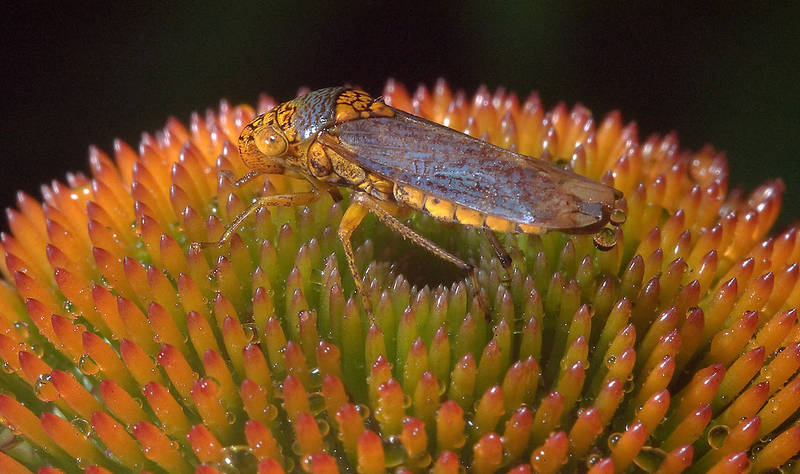

Glassy-winged Sharpshooter bugs (Homalodisca vitripennis) on purple coneflower in Mercer Arboretum and Botanical Gardens. Humble (Houston area), Texas


Album 859: College Station - Mercer Arboretum, Texas, May 13 - 15, 2010
The image depicts a glassy-winged sharpshooter bug perched on the top of a purple coneflower at Mercer Arboretum and Botanical Gardens in Humble (Houston area), Texas. The photograph features two insects: one centered on the flower head, and another partially visible to its left.
The glassy-winged sharpshooter bug is characterized by its yellowish brown coloration with blue wings. Its body appears slightly elongated, indicating it may be a female, as males are typically smaller than females. The insect's legs are positioned in such a way that suggest it has landed on the flower head, possibly to feed on nectar.
The purple coneflower is shown from its side, revealing numerous buds that have not yet bloomed. The flower head is covered with small dew droplets, which may be indicative of recent rainfall or high humidity in the area. The background of the image is dark and indistinct, suggesting it was taken at night or in a heavily shaded area.
Overall, the image captures an intimate moment between a glassy-winged sharpshooter bug and a purple coneflower, highlighting their natural coexistence in a botanical garden setting. – AI vision
🇪🇸 Descripción en español / Spanish Description
El tánato bicudo (Homalodisca vitripennis) sobre una flor púrpura en el Mercer Arboretum y Jardines Botánicos. Humble (área de Houston), Texas, 15 de mayo de 2010. La imagen muestra un tánato bicudo perchado en la parte superior de una flor púrpura en el Mercer Arboretum y Jardines Botánicos en Humble (área de Houston), Texas. En la fotografía se pueden ver dos insectos: uno centrado en la cabeza de la flor y otro parcialmente visible a su izquierda. El tánato bicudo se caracteriza por su coloración parda amarillenta con alas azules. Su cuerpo parece ligeramente alargado, lo que indica que puede ser una hembra, ya que los machos son típicamente más pequeños que las hembras. Las patas del insecto están colocadas de tal manera que sugiere que ha aterrizado en la cabeza de la flor, posiblemente para alimentarse de néctar. La flor púrpura se muestra desde su lado, lo que revela numerosos brotes que todavía no han florecido. La cabeza de la flor está cubierta con pequeñas gotitas de rocío, lo que puede ser indicativo de lluvias recientes o alta humedad en la zona. El fondo de la imagen es oscuro e indistinto, lo que sugiere que se tomó de noche o en un área muy sombreada. En general, la imagen captura un momento íntimo entre un tánato bicudo y una flor púrpura, destacando su coexistencia natural en un entorno de jardín botánico. – Spanish translation