
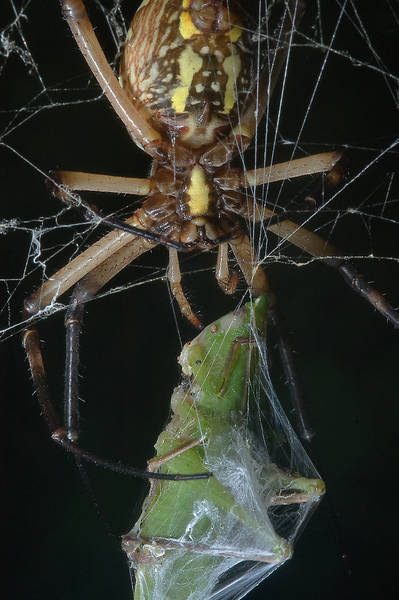

Yellow garden spider (Argiope aurantia) with a green katydid in Lake Bryan Park. Bryan, Texas


Album 886: College Station - Independence, Texas, August 2 - 7, 2010
The image presents a striking scene of an Argiope aurantia, commonly known as the yellow garden spider, entangled with its prey, a green katydid. The spider's body is predominantly brown and tan, adorned with distinctive white spots that form a pattern resembling an hourglass shape on its abdomen.
This iconic marking serves as a visual warning to potential predators that the spider is toxic or distasteful. The katydid, meanwhile, has been captured by the spider's web and now hangs suspended in mid-air near the center of the photograph.
The background of the image features dark shadows surrounding the spider and its prey, while the overall atmosphere exudes an eerie sense of stillness punctuated only by the faint movements of the katydid. The setting is likely a natural environment such as a garden or park, given the presence of the yellow garden spider, which is native to North America.
The photograph appears to have been captured using a high-quality camera with excellent lighting conditions, allowing for a clear and detailed view of both the spider and its prey. The image effectively conveys the intricate relationship between predators and prey in nature, highlighting the strategic placement of the web by the spider to catch unsuspecting insects like the katydid. – AI vision
🇪🇸 Descripción en español / Spanish Description
El araña amarilla de jardín (Argiope aurantia) con una catina verde en el Lake Bryan Park. Bryan, Texas, agosto 4 de 2010. La imagen presenta una escena impactante de una Argiope aurantia, conocida comúnmente como araña amarilla de jardín, enredada con su presa, una catina verde. El cuerpo de la araña es predominantemente marrón y beis, adornado con distintivos puntos blancos que forman un patrón similar a una forma de reloj de arena en su abdomen. Este distintivo sirve como advertencia visual para los posibles depredadores de que la araña es tóxica o desagradable. Mientras tanto, la catina ha sido capturada por la red de la araña y ahora está suspendida en el aire cerca del centro de la fotografía. El fondo de la imagen presenta oscuras sombras que rodean a la araña y su presa, mientras que la atmósfera general emana una sensación inquietante de quietud interrumpida solo por los débiles movimientos de la catina. El escenario es probablemente un entorno natural, como un jardín o parque, teniendo en cuenta la presencia de la araña amarilla de jardín, que es nativa de Norteamérica. La fotografía fue capturada utilizando una cámara de alta calidad con excelentes condiciones de iluminación, lo que permite una vista clara y detallada de tanto la araña como su presa. La imagen transmite efectivamente la intrincada relación entre los depredadores y sus presas en la naturaleza, destacando el emplazamiento estratégico de la red de la araña para atrapar insectos inocentes como la catina. – Spanish translation


