
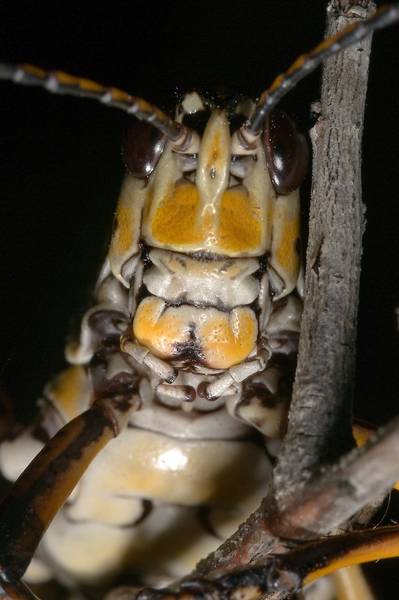

Head of grasshopper in Little Lake Creek Loop Trail in Sam Houston National Forest. Richards, Texas


Album 893: College Station, Texas, September 26 - October 6, 2010
The image presents a detailed close-up view of a grasshopper's head, showcasing its intricate features against the background of a tree branch and leaves. The following description provides an analysis of the image:
* **Grasshopper Head**
* The grasshopper's head is positioned in the center of the image, with its body facing towards the right side.
* Its large, compound eyes are visible on either side of its head, and they appear to be looking directly at the camera.
* A long, pointed mandible protrudes from the lower half of its face, which is likely used for eating and grasping food.
* The grasshopper's antennae are also visible on top of its head, adding to its overall appearance as a formidable insect.
* **Tree Branch**
* A slender tree branch runs vertically through the center of the image, providing a natural frame for the grasshopper's head.
* Small leaves and twigs are attached to the branch, adding texture and depth to the scene.
* **Background**
* The background of the image is dark and blurry, suggesting that it was taken in a forest or woodland area.
* The darkness of the background helps to focus attention on the grasshopper's head and body, creating a sense of intimacy and immediacy.
In summary, the image provides an intimate view of a grasshopper's head, showcasing its unique features and characteristics against the backdrop of a natural environment. – AI vision
🇪🇸 Descripción en español / Spanish Description
Cabeza de saltamontes en Little Lake Creek Loop Trail en el bosque nacional Sam Houston. Richards, Texas, 2 de octubre de 2010. La imagen presenta una vista cercana y detallada de la cabeza de un saltamontes, mostrando sus características intrincadas contra el fondo de una rama de árbol y hojas. La siguiente descripción proporciona un análisis de la imagen:
* **Cabeza de saltamontes**
* La cabeza del saltamontes está ubicada en el centro de la imagen, con su cuerpo mirando hacia el lado derecho.
* Sus grandes ojos compuestos son visibles a cada lado de su cabeza y parecen estar mirando directamente a la cámara.
* Una mandíbula puntiaguda y larga sobresale desde la mitad inferior de su cara, que se utiliza probablemente para comer y agarrar alimentos.
* Las antenas del saltamontes también son visibles encima de su cabeza, lo que suma a su aspecto general como un insecto formidable.
* **Rama de árbol**
* Una rama delgada de un árbol se extiende verticalmente por el centro de la imagen, proporcionando un marco natural para la cabeza del saltamontes.
* Pequeñas hojas y ramitas están unidas a la rama, lo que agrega textura y profundidad a la escena.
* **Fondo**
* El fondo de la imagen es oscuro y borroso, sugiriendo que fue tomada en un bosque o área boscosa.
* La oscuridad del fondo ayuda a concentrar la atención en la cabeza y el cuerpo del saltamontes, creando una sensación de intimidad e inmediatez.
En resumen, la imagen ofrece una vista íntima de la cabeza de un saltamontes, mostrando sus características únicas y distintivas contra el telón de fondo de un entorno natural. – Spanish translation


