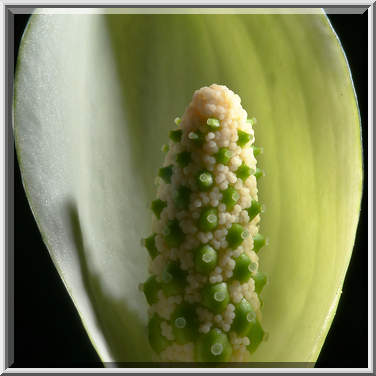
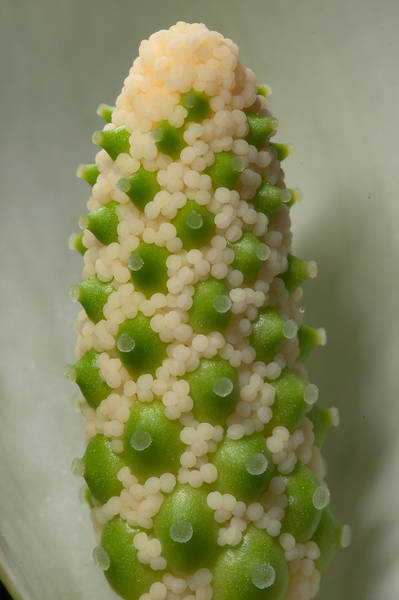
Close up of Wild Calla (Water Arum, Calla palustris) in Sosnovka Park. St.Petersburg, Russia


Album 961: Lisiy Nos, Saint Petersburg, Kuzmolovo, Russia, June 9 - 11, 2011
The image is a close-up photograph of a wild calla plant in bloom. The flower spike appears to be around 2-3 inches long and has an elongated cone shape.
**Key Features:**
* **Coloration:** The base of the flower spike is white, gradually transitioning to green towards the tip.
* **Texture:** Small, round bumps cover the entire length of the plant. These bumps are likely the stamens.
* **Background:** A blurred light-green background suggests that the photograph was taken in a natural setting.
**Conclusion:**
The image provides an intimate look at the structure and growth pattern of a wild calla flower. The gradual color change from white to green along the length of the spike is notable, as is the abundance of small bumps covering its surface. These features are characteristic of the plant's reproductive anatomy. Overall, the image offers a detailed view of this specific species of calla in bloom.
**Answer:** This image depicts the reproductive organ of a wild calla plant, showcasing its unique coloration and texture. The photograph captures the intricate details of the flower spike, providing insight into the structure and growth pattern of this specific species. – AI vision
🇷🇺 Описание по-русски / Russian Description
Этой фотографии изображена дикая тростника (водная арума, Calla palustris) в парке Сосновка. Санкт-Петербург, Россия, 10 июня 2011 года. На изображении показан крупным планом растущий дикий тростник. Длина цветоноса составляет примерно от 2 до 3 дюймов и имеет удлиненную конусовидную форму. **Ключевые черты:** * **Окраска:** База цветоноса белая, постепенно переходящая в зеленый ближе к кончику. * **Текстура:** Маленькие круглые шишки покрывают растение на всем протяжении. Эти бугорки, вероятнее всего, являются тычинками. * **Фон:** Размытый светло-зеленый фон говорит о том, что фотография была сделана в естественной обстановке. * **Заключение:** Изображение дает возможность ближе посмотреть на структуру и паттерн роста дикого тростника. Постепенная смена окраски от белого к зеленому вдоль цветоноса примечательна, как и обилие небольших шишек покрывающих его поверхность. Эти черты характерны для репродуктивной анатомии растения. В целом изображение дает детальное представление о расцветшем диком тростнике. * Ответ: На этом изображении показаны репродуктивные органы дикого тростника, которые характеризуются уникальной окраской и текстурой. Фотография захватывает тонкие подробности цветоноса, давая возможность понять структуру и паттерн роста этого конкретно вида тростника в расцветшем состоянии. – Russian translation


