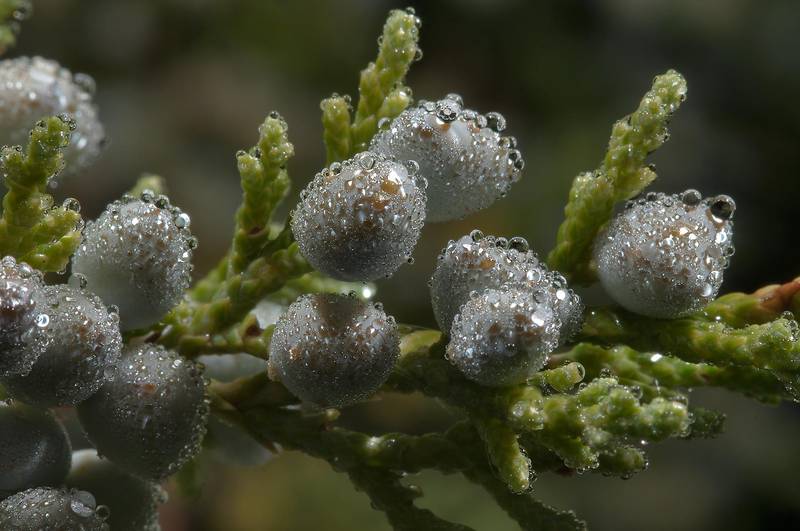

Juniper berries in TAMU Horticultural Gardens in Texas A&M University. College Station, Texas


Album 983: College Station, Washington-on-the-Brazos, Texas, September 25 - October 14, 2011
The image shows a close-up view of juniper berries on a branch, with water droplets covering them. The berries are dark brown to black, spherical or slightly flattened, and about 6-8 mm (0.25-0.3 inches) in diameter. They have a small depression at the top.
**Key Features:**
* **Juniper Berries:** The primary subject of the image is juniper berries, which are an important food source for various animals, including birds, squirrels, and deer.
* **Water Droplets:** Water droplets cover the berries, giving them a shiny appearance. This suggests that it has recently rained or there has been high humidity in the area.
* **Branch Structure:** The branch is greenish-yellow and has a rough texture, with small leaves scattered along its length. The branch appears to be part of a larger tree or shrub.
* **Background:** The background is blurred, but it appears to be a natural environment, possibly a forest or woodland area.
**Overall Impression:**
The image provides a detailed view of juniper berries and their surroundings, highlighting the importance of these plants in their ecosystem. – AI vision
🇪🇸 Descripción en español / Spanish Description
Las bayas de enebro en los Jardines Hortícolas de TAMU en la Universidad Texas A y M. College Station, Texas, 13 de octubre de 2011. La imagen muestra una vista detallada de las bayas de enebro en un ramal, con gotitas de agua que las cubren. Las bayas son de marrón oscuro a negro, esféricas o ligeramente aplanadas, y tienen un diámetro de aproximadamente 6-8 mm (0,25-0,3 pulgadas). Tienen una pequeña depresión en la parte superior. **Características clave:** * **Bayas de enebro:** El tema principal de la imagen son las bayas de enebro, que son una importante fuente de alimento para diversos animales, incluidos pájaros, ardillas y venados. * **Gotitas de agua:** Gotitas de agua cubren las bayas, dándoles un aspecto brillante. Esto sugiere que ha llovido recientemente o que hay alta humedad en el área. * **Estructura del ramal:** El ramal es amarillento verdoso y tiene una textura rugosa, con pequeñas hojas dispersadas a lo largo de su longitud. El ramal parece ser parte de un árbol o arbusto más grande. * **Fondo:** El fondo está borroso, pero parece ser un entorno natural, posiblemente un bosque o una zona boscosa. **Impresión general:** La imagen proporciona una vista detallada de las bayas de enebro y sus alrededores, destacando la importancia de estas plantas en su ecosistema. – Spanish translation