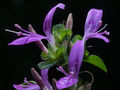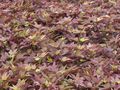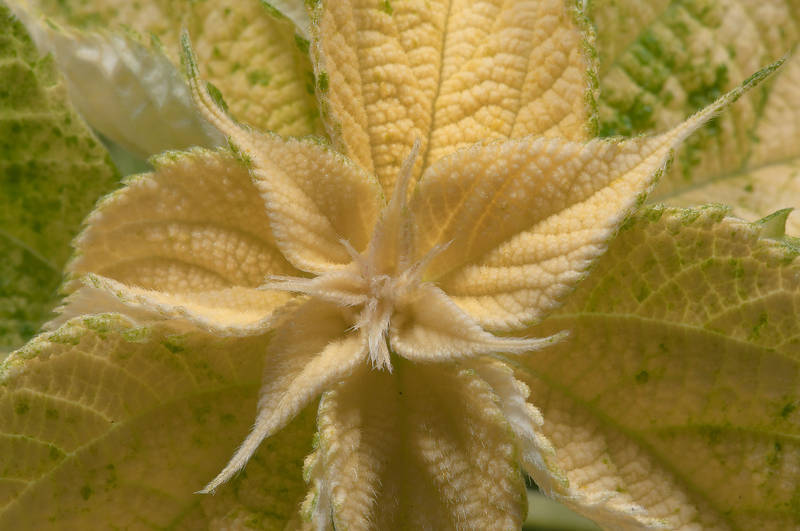

Mint like plant in Mercer Arboretum and Botanical Gardens. Humble (Houston area), Texas


Album 1057: Mercer Arboretum, Texas, May 17, 2012
The image presents a close-up view of a mint-like plant's leaves, showcasing their distinctive features. The plant appears to be situated in a botanical garden or arboretum, as indicated by the caption mentioning Mercer Arboretum and Botanical Gardens.
**Key Features:**
* **Leaf Structure:** The leaves are arranged in a whorled pattern around the stem, with three leaves per node.
* **Coloration:** The leaves display a mottled green and yellow coloration, suggesting that they may be affected by an environmental factor such as sunscald or nutrient deficiencies.
* **Texture:** The leaves have a soft, fuzzy texture, which is typical of mint plants.
* **Venation Pattern:** The leaf venation pattern consists of prominent veins running along the length of each leaf, giving them a characteristic "V" shape.
* **Stem:** The stem appears to be slender and green, with no visible signs of damage or disease.
**Conclusion:**
Based on these observations, it is likely that the plant in question is Mentha sp., commonly known as mint. The whorled leaf arrangement and soft, fuzzy texture are consistent with this genus. However, without further information or a more detailed examination of the plant's characteristics, it is impossible to determine the exact species of mint represented in the image. – AI vision
🇪🇸 Descripción en español / Spanish Description
La planta de la familia de la menta en el Mercer Arboretum and Botanical Gardens. Humble (área de Houston), Texas, 17 de mayo de 2012. La imagen presenta una vista de cerca de las hojas de una planta de la familia de la menta, mostrando sus características distintivas. La planta parece estar situada en un jardín botánico o arboreto, como indica el subtítulo que menciona Mercer Arboretum and Botanical Gardens. **Principales Características:** * **Estructura de las Hojas:** Las hojas están dispuestas en un patrón en espiral alrededor del tallo, con tres hojas por nudo. * **Coloración:** Las hojas presentan una coloración verde moteada, lo que sugiere que pueden estar afectadas por factores ambientales como el insolamiento o deficiencias de nutrientes. * **Textura:** Las hojas tienen una textura suave y peluda, lo que es típico en las plantas de menta. * **Patrón de Venación:** El patrón de venación de las hojas consiste en venas prominentes que discurren a lo largo de cada hoja, dándoles una característica forma en "V". * **Tallo:** El tallo parece ser delgado y verde, sin signos visibles de daño o enfermedad. **Conclusión:** Con base en estas observaciones, es probable que la planta en cuestión sea Mentha sp., comúnmente conocida como menta. La disposición en espiral de las hojas y su textura suave y peluda son consistentes con este género. Sin embargo, sin información adicional o un examen más detallado de las características de la planta, es imposible determinar la especie exacta de menta representada en la imagen. – Spanish translation