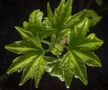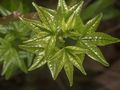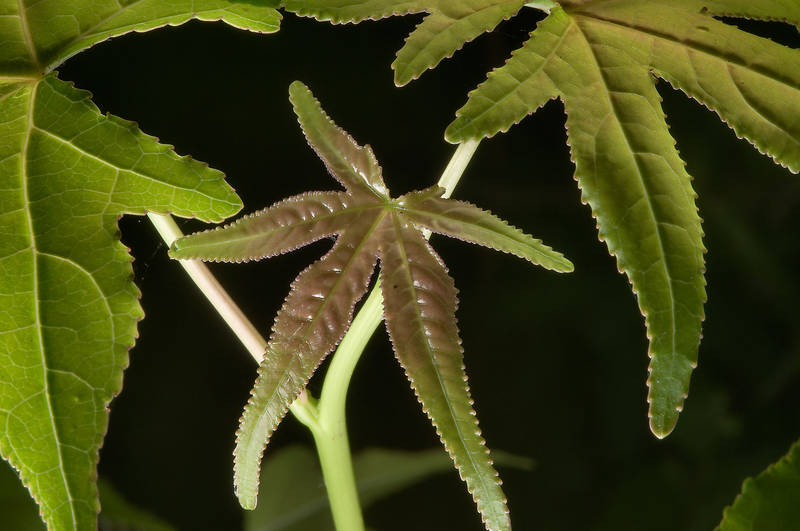

Palmately 5-lobed leaves of sweetgum (Liquidambar) in Little Lake Creek Loop Trail in Sam Houston National Forest. Richards, Texas


Album 1062: College Station - Sam Houston Forest, Texas, May 24 - 26, 2012
The image features a close-up view of the leaves of a Sweetgum tree (Liquidambar spp.). The plant's leaves are palmately divided into five lobes, with serrated edges and varying shades of green, ranging from light to dark.
* **Leaf Structure**
* The leaves are arranged in an alternate pattern on the stem.
* Each leaf is composed of five distinct lobes that radiate outward from a central point.
* The leaf edges are serrated, with small teeth-like structures along their margins.
* **Coloration and Texture**
* The upper surfaces of the leaves display a range of green hues, transitioning from light to dark.
* The undersides of the leaves exhibit a lighter coloration compared to the topside.
* The leaves appear slightly waxy or glossy in texture.
* **Background and Context**
* The background is blurred, with other leaves partially visible in the periphery.
* The overall composition suggests that the image was captured in a natural setting, possibly within a forest or woodland area.
In summary, the image provides a detailed view of the unique leaf structure and coloration of a Sweetgum tree. The palmately divided leaves and serrated edges are characteristic features of this species, while the varying shades of green on the upper surfaces add to their visual interest. – AI vision
🇪🇸 Descripción en español / Spanish Description
Las hojas palmadas de cinco lóbulos del palo de canela (Liquidambar) en el Little Lake Creek Loop Trail en la Sam Houston National Forest. Richards, Texas, mayo de 2012. La imagen muestra una vista de cerca de las hojas de un árbol de palo de canela (Liquidambar spp.). Las hojas de la planta están divididas en cinco lóbulos palmeados, con bordes dentados y tonalidades de verde variadas, que van del claro al oscuro.
Estructura foliar:
Las hojas están dispuestas en un patrón alterno en el tallo.
Cada hoja está compuesta por cinco lóbulos distintos que se irradian hacia afuera desde un punto central.
Los bordes de las hojas son dentados, con pequeñas estructuras en forma de dientes a lo largo de sus márgenes.
Coloración y textura:
Las superficies superiores de las hojas presentan una gama de tonos de verde, que pasan del claro al oscuro.
El lado inferior de las hojas muestra una coloración más clara en comparación con la parte superior.
Las hojas tienen un aspecto ligeramente ceroso o brillante.
Contexto y antecedentes:
El fondo está borroso, con otras hojas parcialmente visibles en la periferia.
La composición general sugiere que la imagen se capturó en un entorno natural, posiblemente dentro de un bosque o área arbolada.
En resumen, la imagen proporciona una vista detallada de la única estructura y coloración de las hojas de un árbol de palo de canela. Los bordes palmeados y dentados son características distintivas de esta especie, mientras que los diversos tonos de verde en las superficies superiores aumentan su interés visual. – Spanish translation