
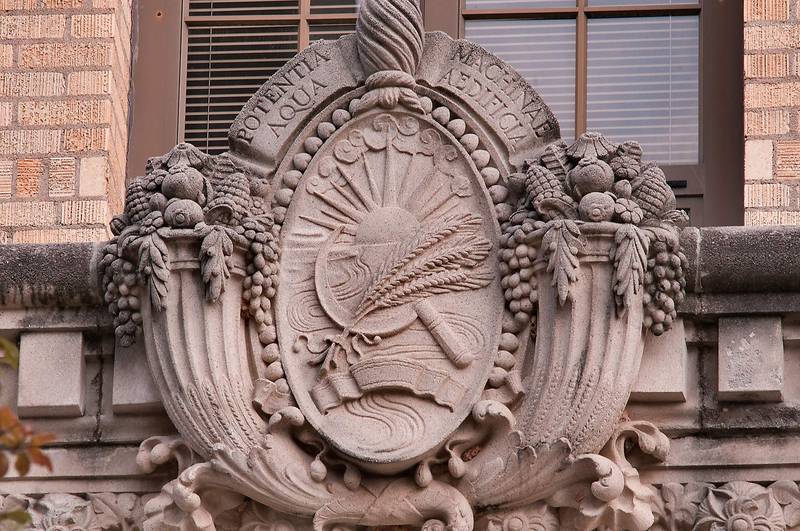

Decoration over the entrance of Agricultural Engineering Building (Scoates Hall, 1932) on campus of Texas A&M University. College Station, Texas


Album 1113: Washington-on-the-Brazos - College Station, Texas, October 20 - 23, 2012
The image shows a close-up view of an ornate stone decoration over the entrance to Scoates Hall (Agricultural Engineering Building) at Texas A&M University in College Station, Texas.
**Architectural Design**
* The decoration is centered within an oval shape.
* It features three bundles of wheat with stalks and leaves emanating from them.
* Each bundle has a sheaf of grain tied together with two ribbons or strings, forming the central element of the oval.
* A sunburst radiates behind the sheaves in a circle that is slightly smaller than the outer edge of the oval.
**Surrounding Elements**
* The decoration is surrounded by an outer ring featuring several clusters of grapes and leaves at regular intervals.
* At each corner, there are two bunches of fruit which may be figs or pomegranates.
* A small portion of a leafed vine can also be seen on either side of the sunburst.
**Latin Inscription**
* The decoration features an inscription in Latin that reads "Potentia Aqua" at the top and "Aedificium" (building) at the bottom.
* The words are arranged around the edge of the oval, with "Potentia Aqua" above and "Aedificium" below.
**Overall Design**
* The overall design is likely intended to represent the importance of water in agriculture.
* The presence of fruit clusters and a vine suggests that the building may also be associated with horticulture or gardening. – AI vision
🇪🇸 Descripción en español / Spanish Description
Decoración sobre la entrada del edificio de Ingeniería Agrícola (Scoates Hall, 1932) en el campus de la Universidad A&M de Texas. College Station, Texas, 21 de octubre de 2012. La imagen muestra una vista en primer plano de una decoración de piedra ornamentada sobre la entrada del Scoates Hall (Edificio de Ingeniería Agrícola) en la Universidad A&M de Texas en College Station, Texas. **Diseño Arquitectónico** * La decoración está centrada dentro de una forma oval. * Presenta tres racimos de trigo con tallos y hojas que emanan desde ellos. * Cada ramo tiene un mazo de grano atado con dos cintas o cuerdas, formando el elemento central del óvalo. * Una explosión solar irradia detrás de los mazos en un círculo que es ligeramente más pequeño que el borde exterior del óvalo. **Elementos circundantes** * La decoración está rodeada por un anillo externo con varios racimos de uvas y hojas a intervalos regulares. * En cada esquina hay dos racimos de frutas, que pueden ser higos o granadas. * También se puede observar una pequeña parte de una vid con hojas en cada lado de la explosión solar. **Inscripción en Latín** * La decoración presenta una inscripción en latín que dice "Potentia Aqua" en la parte superior e "Aedificium" (edificio) en la parte inferior. * Las palabras están dispuestas alrededor del borde del óvalo, con "Potentia Aqua" encima y "Aedificium" abajo. **Diseño general** * El diseño general está pensado para representar la importancia del agua en la agricultura. * La presencia de racimos de fruta y una vid sugiere que el edificio también puede estar asociado con horticultura o jardinería. – Spanish translation


