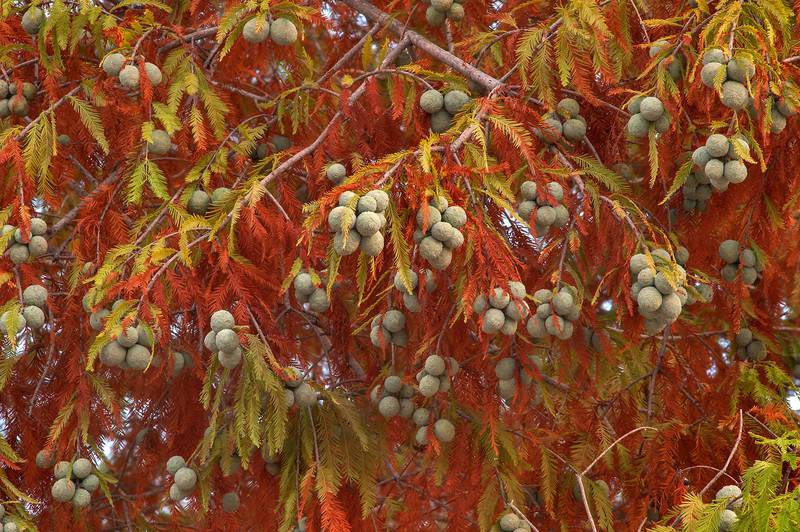

Marsh cypress with cones in TAMU Horticultural Gardens in Texas A&M University. College Station, Texas


Album 1237: Texas - Saint Petersburg, Russia, August 11 - 21, 2013
The image depicts a vibrant tree with distinctive orange-red foliage and clusters of greenish-brown cones, showcasing its unique characteristics. The tree's leaves are long and thin, measuring approximately 2-5 inches in length, with a soft, feathery texture.
**Key Features:**
* **Foliage:** Orange-red coloration
* **Leaf Shape and Size:** Long and thin, approximately 2-5 inches in length
* **Texture:** Soft, feathery
The tree appears to be thriving, with several branches extending from the trunk. The presence of cones suggests that it is a coniferous species, specifically the Marsh cypress (Taxodium distichum). This type of tree is native to North America and is commonly found in wetland areas.
**Background:**
* **Setting:** TAMU Horticultural Gardens
* **Location:** College Station, Texas
Overall, the image provides a detailed view of the Marsh cypress tree's unique features, highlighting its striking foliage and cone-bearing capabilities. – AI vision
🇪🇸 Descripción en español / Spanish Description
El ciprés de palud con conos en los jardines hortícolas TAMU en Texas A y M University. College Station, Texas, 16 de agosto de 2013. La imagen muestra un árbol vibrante con distintivo follaje de color rojo anaranjado y racimos de conos marrones verdosos, mostrando sus características únicas. Las hojas del árbol son largas y delgadas, midiendo aproximadamente de 2 a 5 pulgadas de longitud, con una textura suave y plumosa. **Características clave:** * **Follaje:** Coloración rojo anaranjado * **Forma y tamaño de las hojas:** Largo y delgado, aproximadamente de 2 a 5 pulgadas de longitud * **Textura:** Suave, plumoso El árbol parece estar prosperando, con varias ramas extendiéndose desde el tronco. La presencia de los conos sugiere que es una especie conífera, específicamente el ciprés de palud (Taxodium distichum). Este tipo de árbol es nativo de América del Norte y se encuentra comúnmente en zonas húmedas. **Antecedentes:** * **Entorno:** Jardines hortícolas TAMU * **Localización:** College Station, Texas En general, la imagen proporciona una vista detallada de las características únicas del árbol ciprés de palud, destacando su follaje impactante y su capacidad para llevar conos. – Spanish translation