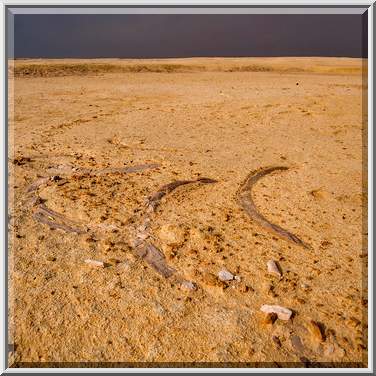


Small mound with fossilized dugong bones in area of coastal sabkha in south-western Qatar


Album 1336: Fossil tour in south-western Qatar, February 7, 2014
The image depicts a small mound situated in an area of coastal sabkha in southwestern Qatar. The photograph is taken from a low angle and captures the mound's top half, with its base extending beyond the frame.
The mound itself appears to be composed primarily of tan-colored sedimentary rock or mudstone, featuring a rough texture that suggests it has been eroded by wind or water over time. A small, dark gray area is visible towards the center of the mound, which may indicate the presence of fossils.
In the background, a vast expanse of flat terrain stretches out to the horizon, punctuated by distant hills and ridges. The sky above is an overcast grayish-blue hue, suggesting that the photograph was taken on an overcast day in late February or early March 2014. – AI vision


