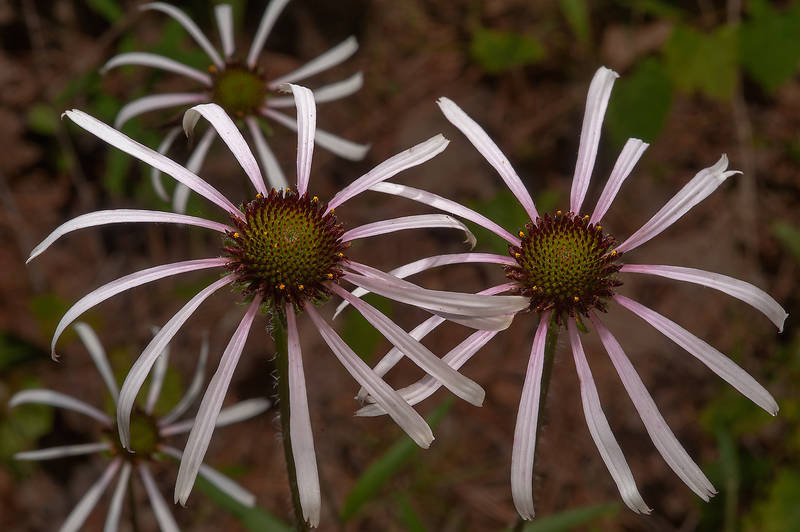

Blooming coneflowers (Echinacea sanguinea) in Sam Houston National Forest, on Little Lake Creek Loop Trail. Richards, Texas

Album 1411: Flowers in Sam Houston National Forest, Texas, May 18, 2014
The image presents a close-up view of three coneflowers (Echinacea sanguinea) in bloom, situated along the Little Lake Creek Loop Trail within Sam Houston National Forest in Richards, Texas. The flowers are centered in the frame and appear to be growing from the ground.
Each flower has ten white petals that curve outward from a central green disk, giving it a distinctive appearance. The background of the image is blurred, but appears to feature other plants and possibly dirt or soil. The overall effect suggests that the photograph was taken during the day, as the lighting is bright enough to highlight the details of the flowers.
The presence of three coneflowers in close proximity implies that they may be growing in a cluster, which could indicate a favorable microenvironment for their growth. This might include factors such as adequate moisture, sunlight, and nutrients. The fact that they are blooming during the spring season (May) suggests that this time of year is conducive to their growth.
Overall, the image provides a detailed view of these beautiful wildflowers in their natural habitat. – AI vision
🇪🇸 Descripción en español / Spanish Description
Las margaritas de pico de conejo (Echinacea sanguinea) florecen en el Little Lake Creek Loop Trail de la Sam Houston National Forest. Richards, Texas, 18 de mayo de 2014. La imagen presenta una vista cercana de tres margaritas de pico de conejo (Echinacea sanguinea) floreciendo, ubicadas a lo largo del Little Lake Creek Loop Trail dentro de la Sam Houston National Forest en Richards, Texas. Las flores están centradas en el marco y parecen estar creciendo desde el suelo. Cada flor tiene diez pétalos blancos que se curvan hacia fuera desde un disco verde central, dándole un aspecto distintivo. El fondo de la imagen está borroso, pero parece presentar otras plantas y posiblemente tierra o suelo. El efecto general sugiere que la fotografía fue tomada durante el día, ya que la iluminación es lo suficientemente brillante como para resaltar los detalles de las flores. La presencia de tres margaritas de pico de conejo muy cerca uno del otro implica que pueden estar creciendo en un racimo, lo que podría indicar un microentorno favorable para su crecimiento. Esto puede incluir factores como humedad adecuada, luz solar y nutrientes. El hecho de que estén floreciendo durante la temporada de primavera (mayo) sugiere que esta época del año es propicia para su crecimiento. En general, la imagen proporciona una vista detallada de estas hermosas flores silvestres en su hábitat natural. – Spanish translation