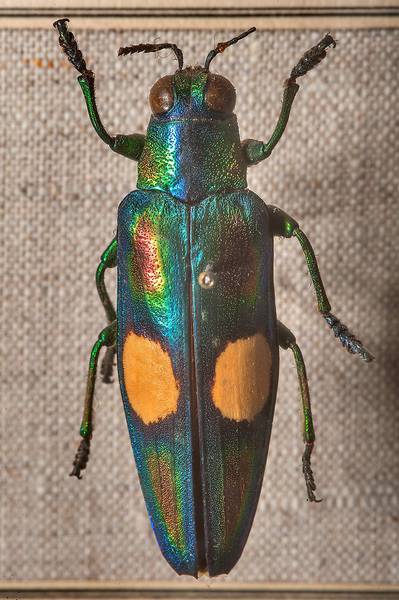

Mounted Jewel beetle Chrysochroa ocellata in Zoological Museum. St.Petersburg, Russia


Album 1431: Saint Petersburg, Russia, June 10 - 11, 2014
The image depicts a mounted specimen of the Jewel Beetle (Chrysochroa ocellata) on display at the Zoological Museum in St. Petersburg, Russia. The beetle is positioned with its back facing the camera, showcasing its vibrant iridescent green coloration and distinctive features.
**Physical Description**
* The beetle's body is elongated, measuring approximately 2-3 centimeters in length.
* Its elytra (wing covers) are a deep green hue, exhibiting an iridescent sheen that reflects light.
* Two large yellow spots adorn the middle of each elytron, adding to the beetle's striking appearance.
**Facial Features**
* The beetle's head is rounded and features two antennae protruding from the top, which are long and slender with a club-like structure at the end.
* Its eyes are small but prominent, giving the insect a keen sense of vision.
* A pair of mandibles (jaws) can be seen below the eyes, used for chewing and manipulating food.
**Mounting and Background**
* The beetle is mounted on a rectangular piece of cork or cardboard, providing support and stability.
* The background behind the beetle appears to be a beige-colored fabric or paper, which helps to highlight the insect's colors and features.
**Overall Impression**
* The image presents a clear and detailed view of the Jewel Beetle's physical characteristics, showcasing its unique appearance and fascinating features. – AI vision
🇷🇺 Описание по-русски / Russian Description
В музее зоологии. Санкт-Петербург, Россия, 11 июня 2014 г. На изображении представлены внешний вид и подробное описание драгоценного жука Chrysochroa ocellata на выставке в музее зоологии Санкт-Петербурга, Россия. Жук расположен спиной к камере, демонстрируя свою яркую иризационную зеленую окраску и отличительные черты. **Физическое описание** * Тело жука удлиненное, длина примерно 2-3 сантиметра. * Крылья (крылья) темно-зеленого цвета, обладают иризацией, которая отражает свет. * Два больших желтых пятна украшают середину каждого крыла, добавляя жуку яркость. **Внешний вид** * Голова жука округлая и имеет две выступающие антенны сверху, которые длинные и тонкие с букликом на конце. * Его глаза небольшие, но заметные, придающие насекомому четкое зрение. * Пара челюстей (челюсти) видна под глазами, используются для пережевывания и манипулирования пищей. **Способ крепления и фон** * Жук прикреплен к прямоугольному куску пробки или картона, обеспечивающему поддержку и стабильность. * Фон позади жука кажется бежевой тканью или бумагой, которая помогает выделить цвета и черты насекомого. **Общее впечатление** * На изображении представлен четкий и детальный вид драгоценного жука Chrysochroa ocellata с его физическими характеристиками, показывающими уникальную внешность и удивительные черты. – Russian translation