
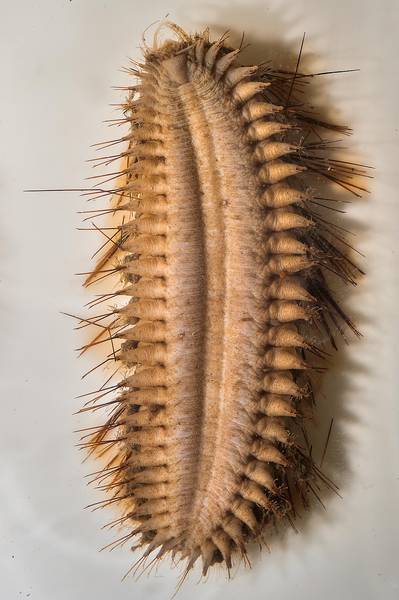

Sea animal Hermione hystrix in Zoological Museum. St.Petersburg, Russia


Album 1432: Saint Petersburg - Pskov Region, Russia, June 11 - 12, 2014
The image depicts a specimen of the sea animal Hermione hystrix, which is stored at the Zoological Museum in Saint Petersburg, Russia. The photo was taken on June 11, 2014.
The Hermione hystrix, also known as the "thorny oyster," is a species of marine bivalve mollusc belonging to the family Eomphalotrochidae. It has a distinctive appearance, with a long, slender shell covered in spines and a mouthpart featuring a unique structure resembling an upside-down cup.
The Hermione hystrix is found primarily in tropical waters around the world, including the Indo-Pacific region and the Caribbean Sea. It inhabits shallow coastal areas, often living among coral reefs or rocky crevices.
In terms of size, the Hermione hystrix can grow up to 20 centimeters (8 inches) in length, although most individuals are significantly smaller. Its shell is typically brownish-gray in color, with a smooth surface and a rounded apex.
The mouthpart of the Hermione hystrix is perhaps its most striking feature. It has a unique structure that resembles an upside-down cup, complete with a rimmed edge and a hollow interior. This mouthpart is thought to be used for capturing prey, such as small fish or crustaceans.
Overall, the Hermione hystrix is an intriguing and visually appealing species that continues to fascinate scientists and marine enthusiasts alike. Its distinctive appearance and unique adaptations make it a valuable subject of study in the field of malacology (the study of molluscs). – AI vision
🇷🇺 Описание по-русски / Russian Description
В зоологическом музее. Санкт-Петербург, Россия, 11 июня 2014 года. На изображении представлен образец морского животного Hermione hystrix, хранящийся в Зоологическом музее в Санкт-Петербурге, России. Фотография была сделана 11 июня 2014 года. Гирьоне гистрикс, также известный как "колючий устрица", является видом морского двустворчатого моллюска семейства Eomphalotrochidae. Он имеет характерную внешность с длинной, стройной раковиной, покрытой шипами, и частью рта со структурой, напоминающей перевернутую чашку. Гирьоне гистрикс преимущественно обитает в тропических водах по всему миру, включая Индо-Тихоокеанский регион и Карибское море. Он обитает в мелких прибрежных зонах, часто среди коралловых рифов или каменистых расщелин. С точки зрения размеров Гирьоне гистрикс может вырастать до 20 сантиметров (8 дюймов) в длину, хотя большинство особей значительно меньше. Его раковина обычно буровато-серые цвета со сглаженной поверхностью и округлым верхом. Часть рта у Гирьоне гистрикса является, возможно, его наиболее яркой особенностью. У нее есть уникальная структура, напоминающая перевернутую чашку, с ободком и пустотой внутри. Считается, что эта часть рта используется для захвата добычи, такой как маленькие рыбки или ракообразные. В целом, Гирьоне гистрикс является интригующим и визуально привлекательным видом, который продолжает очаровывать ученых и морских энтузиастов. Его отличительная внешность и уникальные адаптации делают его ценным объектом изучения в области малакологии (исследования моллюсков). – Russian translation


