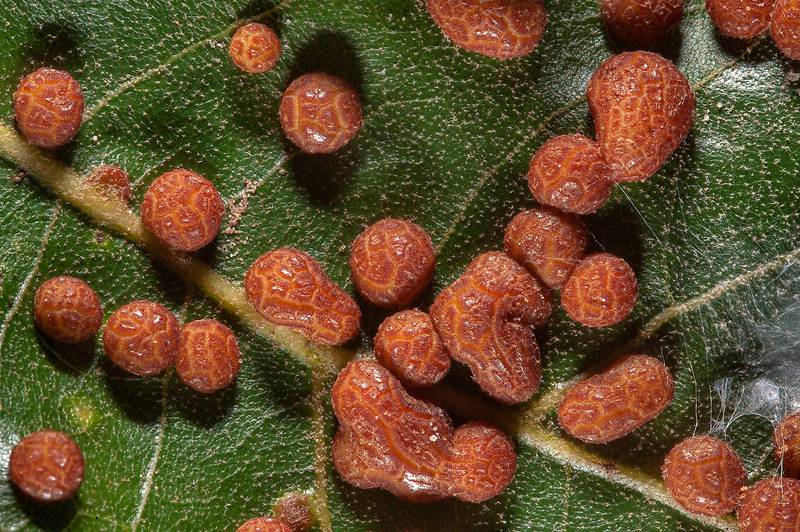

Close up of galls on an oak leaf near Birch Creek Unit of Somerville Lake State Park. Texas


Album 1462: Lake Somerville, Texas, July 19, 2014
The image presents a close-up view of a green oak leaf featuring numerous small, brownish-red structures resembling tiny acorns or growths. These structures are likely galls, which are abnormal growths that occur on plants due to various factors such as insect infestations, fungal infections, or environmental stressors.
**Key Features:**
* **Leaf Appearance:** The leaf exhibits a vibrant green color with visible veins and serrated edges.
* **Gall Distribution:** The galls are randomly distributed across the leaf's surface, with some appearing more prominent than others.
* **Coloration:** The galls display a range of brownish-red hues, from light tan to deep reddish-brown.
* **Size Variation:** The sizes of the galls vary significantly, ranging from tiny, pinhead-sized structures to larger, pea-sized growths.
**Possible Causes and Implications:**
* **Insect Infestation:** The presence of these galls could indicate an infestation by insects such as aphids, whiteflies, or scale insects.
* **Fungal Infection:** Alternatively, the galls might be caused by fungal pathogens that infect the leaf tissue, leading to abnormal growths.
* **Environmental Stressors:** Environmental stressors like temperature fluctuations, humidity changes, or exposure to pollutants could also contribute to gall formation.
**Conclusion:**
The image depicts a close-up view of an oak leaf with numerous galls, which may be caused by various factors including insect infestations, fungal infections, or environmental stressors. Further examination and analysis would be necessary to determine the exact cause of these growths. – AI vision
🇪🇸 Descripción en español / Spanish Description
Se muestra de cerca una hoja de roble con numerosas yemas en la Unidad Birch Creek del Parque Estatal Somerville Lake, Texas, el 19 de julio de 2014. La imagen presenta una vista de cerca de una hoja de color verde oscuro que muestra numerosas estructuras parduzcas-rojizas que se asemejan a pequeños cornejos o crecimientos. Estas estructuras son probablemente yemas, que son crecimientos anormales que se producen en las plantas debido a varios factores como infestaciones de insectos, infecciones fúngicas o estresantes ambientales. **Características clave:** * **Aspecto de la hoja:** La hoja presenta un vibrante color verde con venas visibles y bordes serrados. * **Distribución de las yemas:** Las yemas se distribuyen aleatoriamente por toda la superficie de la hoja, siendo algunas más prominentes que otras. * **Coloración:** Las yemas presentan una variedad de tonos parduzcos-rojizos, desde un ligero color tostado hasta un oscuro color marrón rojizo. * **Tamaño variable:** El tamaño de las yemas varía significativamente, pasando de pequeñas estructuras del tamaño de una cabeza de alfiler a crecimientos más grandes del tamaño de un guisante. **Posibles causas e implicaciones:** * **Infestación por insectos:** La presencia de estas yemas podría indicar una infestación por insectos como áfidos, moscas blancas o ácaros. * **Infección fúngica:** Alternativamente, las yemas pueden ser causadas por patógenos fúngicos que infectan el tejido de la hoja, lo que causa crecimientos anormales. * **Estresantes ambientales:** Factores ambientales como fluctuaciones de temperatura, cambios de humedad o exposición a contaminantes también podrían contribuir a la formación de yemas. **Conclusión:** La imagen muestra una vista de cerca de una hoja de roble con numerosas yemas, que pueden ser causadas por varios factores incluyendo infestaciones de insectos, infecciones fúngicas o estresantes ambientales. Se necesitaría un examen más detallado y análisis para determinar la causa exacta de estos crecimientos. – Spanish translation