
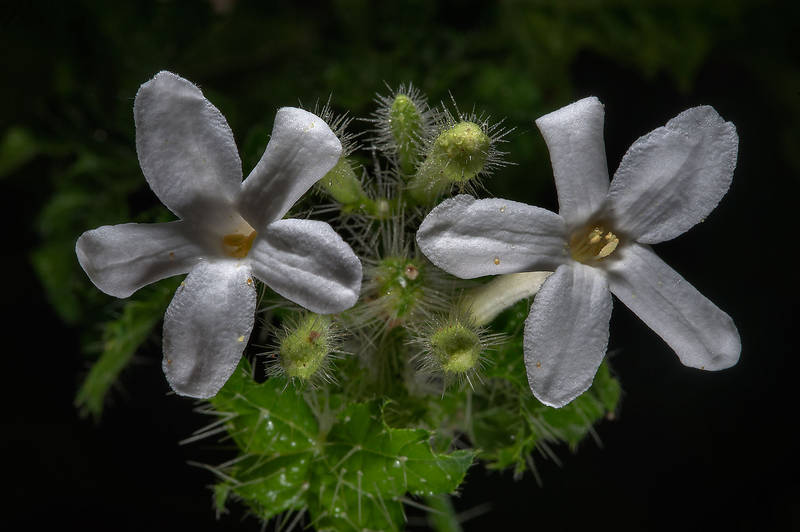

Bull nettle (mala mujer, Cnidoscolus texanus) in Washington-on-the-Brazos State Historic Site. Washington, Texas


Album 1466: Washington-on-the-Brazos - Independence, Texas, July 25, 2014
The image showcases a bull nettle flower (Cnidoscolus texanus), also known as mala mujer. The flowers are white and five-petaled, with a yellow center, while the leaves are green and jagged. The plant is covered in fine hairs that give it an appearance similar to a cactus. The background features more greenery from other plants.
The image was captured on July 25, 2014, at Washington-on-the-Brazos State Historic Site in Texas. This location likely holds historical significance as a former state capital of the Republic of Texas and later part of the United States. The presence of the bull nettle flower suggests that the site is located in an area with a temperate climate, allowing for this plant to thrive.
The caption provides context to the image by including the common name "mala mujer," which translates from Spanish as "evil woman" or "bad woman." This name likely refers to the plant's sharp hairs and thorns that can cause discomfort if touched. The botanical name Cnidoscolus texanus indicates its classification within the genus Cnidoscolus, a group of plants known for their spiny stems and leaves.
Overall, the image provides a detailed view of a bull nettle flower in its natural habitat, highlighting its unique characteristics and significance within the ecosystem. – AI vision
🇪🇸 Descripción en español / Spanish Description
La ortiga toro (mala mujer, Cnidoscolus texanus) en el sitio histórico estatal de Washington-on-the-Brazos. Washington, Texas, 25 de julio de 2014. La imagen muestra una flor de ortiga toro (Cnidoscolus texanus), también conocida como mala mujer. Las flores son blancas y de cinco pétalos, con un centro amarillo, mientras que las hojas son verdes y dentadas. La planta está cubierta de pelos finos que le dan una apariencia similar a un cactus. El fondo presenta más vegetación de otras plantas. La imagen se capturó el 25 de julio de 2014 en el sitio histórico estatal de Washington-on-the-Brazos en Texas. Este lugar probablemente tenga significado histórico como antigua capital del estado de la República de Texas y, posteriormente, parte de los Estados Unidos. La presencia de la flor de ortiga toro sugiere que el sitio se encuentra en una zona con clima templado, lo que permite que esta planta prospere. El subtítulo proporciona contexto a la imagen al incluir el nombre común "mala mujer", que se traduce del español como "mujer malvada" o "mala mujer". Este nombre probablemente se refiere a los pelos y espinas afilados de la planta que pueden causar molestias si se tocan. El nombre científico Cnidoscolus texanus indica su clasificación dentro del género Cnidoscolus, un grupo de plantas conocidas por sus tallos y hojas espinosos. En general, la imagen proporciona una vista detallada de una flor de ortiga toro en su hábitat natural, resaltando sus características únicas y su importancia dentro del ecosistema. – Spanish translation


