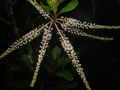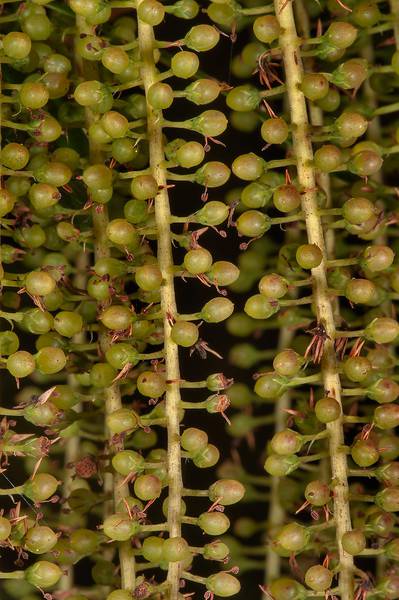

Catkins on a bush of Cyrilla racemiflora in Watson Rare Native Plant Preserve. Warren, Texas


Album 1472: Watson Preserve - Big Thicket, Warren, Texas, August 2, 2014
**Description of the Image**
The image presents a close-up view of catkins growing on a bush of **Cyrilla racemiflora**, commonly known as the **coastal sweetpepperbush** or **calabash tree**.
**Key Features:**
* The catkins are characterized by their small, greenish-yellow appearance and elongated shape.
* They grow in clusters along the stems of the plant, forming a dense arrangement that gives the bush a lush appearance.
* The catkins are likely to be unisexual, meaning they contain either male or female reproductive organs but not both, which is common in dioecious plants.
**Context:**
The image was captured at **Watson Rare Native Plant Preserve**, situated in **Warren, Texas**, on August 2, 2014. The timing of the photo suggests that it was taken during late summer when the plant is likely to be in full bloom or producing fruit.
**Overall Observation:**
The image provides a detailed look at the reproductive structures of Cyrilla racemiflora, highlighting its unique catkin morphology and growth pattern. This information can be useful for botanists, horticulturists, and anyone interested in understanding the biology of this plant species. – AI vision
🇪🇸 Descripción en español / Spanish Description
Traducción:
Flores masculinas en un arbusto de Cyrilla racemiflora en la reserva de plantas nativas raras Watson. Warren, Texas, 2 de agosto de 2014. **Descripción de la imagen** La imagen presenta una vista cercana de las flores masculinas que crecen en un arbusto de Cyrilla racemiflora, comúnmente conocido como el "coastal sweetpepperbush" o "árbol calabaza". **Características clave:** * Las flores masculinas se caracterizan por su apariencia amarillo verdosa y alargada. * Ellas crecen en racimos a lo largo de los tallos de la planta, formando una disposición densa que le da al arbusto un aspecto lujoso. * Es probable que las flores masculinas sean unisexuales, lo que significa que contienen órganos reproductores masculinos o femeninos pero no ambos, lo que es común en plantas dioicas. **Contexto:** La imagen fue capturada en la reserva de plantas nativas raras Watson, situado en Warren, Texas, el 2 de agosto de 2014. El momento de la foto sugiere que se tomó a finales del verano cuando la planta probablemente esté en plena floración o produciendo frutos. **Observación general:** La imagen proporciona una mirada detallada a las estructuras reproductivas de Cyrilla racemiflora, destacando su única morfología de flores masculinas y el patrón de crecimiento. Esta información puede ser útil para botánicos, horticultores y cualquiera interesado en comprender la biología de esta especie de planta. – Spanish translation