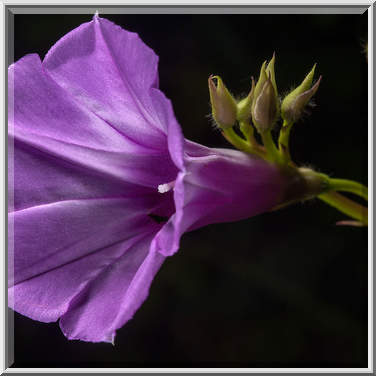
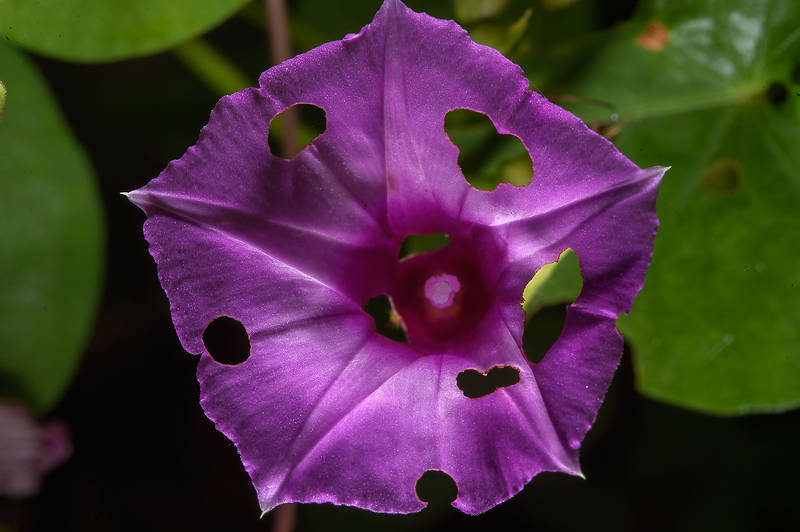
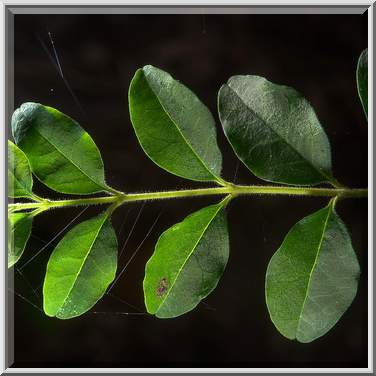
Flower of Morning Glory (tievine, Ipomoea cordatotriloba) eaten by insects in Bee Creek Park. College Station, Texas

Album 1477: College Station, Texas, August 10 - 12, 2014
The image presents a close-up view of a vibrant purple flower, likely belonging to the Morning Glory (tievine, Ipomoea cordatotriloba) species, nestled within Bee Creek Park in College Station, Texas. The photograph was taken on August 11, 2014.
Upon closer inspection, the flower's petals exhibit several small holes, indicating that it has been partially consumed by insects. The delicate purple hue of the flower is accentuated by its slightly ruffled edges and a subtle sheen that catches the light.
In the background, lush green leaves are visible, providing a natural contrast to the bright purple bloom. These leaves are likely from the same plant as the flower or possibly from another nearby Morning Glory plant.
The image suggests that the insects responsible for consuming part of the flower have been attracted by its sweet nectar and fragrance. The presence of these holes on the petals implies that the insects, possibly butterflies or moths, have fed on the flower's resources while pollinating it in the process.
Overall, this photograph captures a moment in time where nature's cycles are at play, highlighting the intricate relationships between plants and their pollinators. – AI vision
🇪🇸 Descripción en español / Spanish Description
Flor de Gloriosa (tievine, Ipomoea cordatotriloba) comida por insectos en Bee Creek Park. College Station, Texas, el 11 de agosto de 2014. La imagen presenta una vista detallada de una flor púrpura vibrante, probablemente perteneciente a la especie Gloriosa (tievine, Ipomoea cordatotriloba), anidada dentro del Bee Creek Park en College Station, Texas. La fotografía fue tomada el 11 de agosto de 2014. Al inspeccionarlo más de cerca, los pétalos de la flor presentan varios pequeños agujeros, lo que indica que ha sido parcialmente consumida por insectos. El matiz púrpura delicado de la flor está acentuado por sus bordes ligeramente arrugados y un brillo sutil que capta la luz. En el fondo, son visibles hojas verdes jugosas, proporcionando un contraste natural con la flor púrpura brillante. Estas hojas son probablemente de la misma planta que la flor o posiblemente de otra planta Gloriosa cercana. La imagen sugiere que los insectos responsables de consumir parte de la flor han sido atraídos por su dulce néctar y fragancia. La presencia de estos agujeros en los pétalos implica que los insectos, posiblemente mariposas o polillas, se han alimentado de los recursos de la flor al mismo tiempo que la polinizaban. En general, esta fotografía captura un momento en el tiempo donde los ciclos de la naturaleza están en juego, resaltando las relaciones intrincadas entre plantas y sus polinizadores. – Spanish translation


