
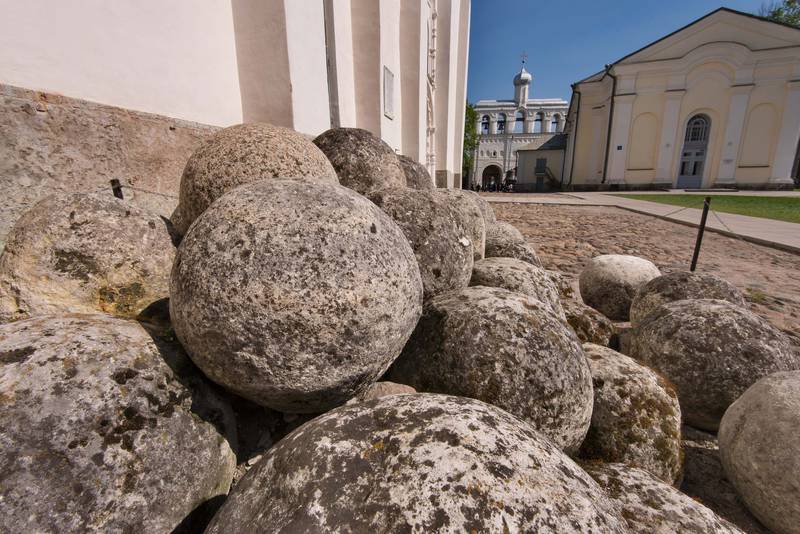

Stone cannon balls near Sofiysky Cathedral in Kremlin area. Novgorod, Russia


Album 1821: Novgorod - Tosna, Russia, May 7 - 8, 2016
The image depicts a collection of stone cannonballs situated adjacent to the Sofiysky Cathedral within the Kremlin area of Novgorod, Russia. The photograph was captured on May 7, 2016.
In the foreground, several large, spherical cannonballs are arranged in a pile near the cathedral's wall. These cannonballs appear to be made of stone and exhibit a rough texture, with some displaying patches of moss or lichen growth. They vary in size but generally range from approximately two to three feet in diameter.
The cathedral itself is visible in the background, featuring a cream-colored façade adorned with white trim. Its design incorporates elements such as arches and columns, suggesting an architectural style reminiscent of Russian Orthodox churches during the 15th century. A small dome crowns the building's center, adding to its distinctive appearance.
A paved path leads up to the cathedral entrance, situated on the left side of the image. The surrounding area is characterized by a mix of grassy patches and dirt or gravel, with no visible signs of recent construction or renovation activity.
The overall atmosphere of the scene appears tranquil, evoking a sense of historical significance and cultural heritage. The presence of these ancient cannonballs serves as a poignant reminder of the region's rich history, while the cathedral itself stands as a testament to the enduring legacy of Russian Orthodox architecture. – AI vision
🇷🇺 Описание по-русски / Russian Description
Каменные ядра пушек около Софийского собора в Кремле. Новгород, Россия, 7 мая 2016 года. На изображении видно множество каменных ядер пушек, расположенных рядом с Софийским собором в кремле Новгорода, Россия. Фотография была сделана 7 мая 2016 года. На переднем плане, несколько крупных, шарообразных ядер пушек уложены в кучу возле стены собора. Эти ядра выполнены из камня и имеют шероховатую текстуру, некоторые с потеками мха или лишайника. Они различаются по размеру, но обычно составляют приблизительно от двух до трех футов в диаметре. Собор виден на заднем плане, его фасад выкрашен в кремовый цвет и украшен белой отделкой. Его конструкция включает такие элементы, как арки и колонны, что свидетельствует об архитектурном стиле, напоминающем русские православные церкви 15-го века. Маленький купол венчает здание в центре, добавляя отличий внешности. Мощеный путь ведет к соборному входу, расположенному слева на изображении. Окружающая местность характеризуется смесью луж и грязи или гравия, без видимых признаков недавнего строительства или ремонта. Общее впечатление от сцены спокойное, что напоминает о ее историческом значении и культурном достоянии. Наличие этих древних ядер пушек служит душераздирающим напоминанием богатой истории региона, в то время как собор сам по себе служит свидетельством прочного наследия русской православной архитектуры. – Russian translation


