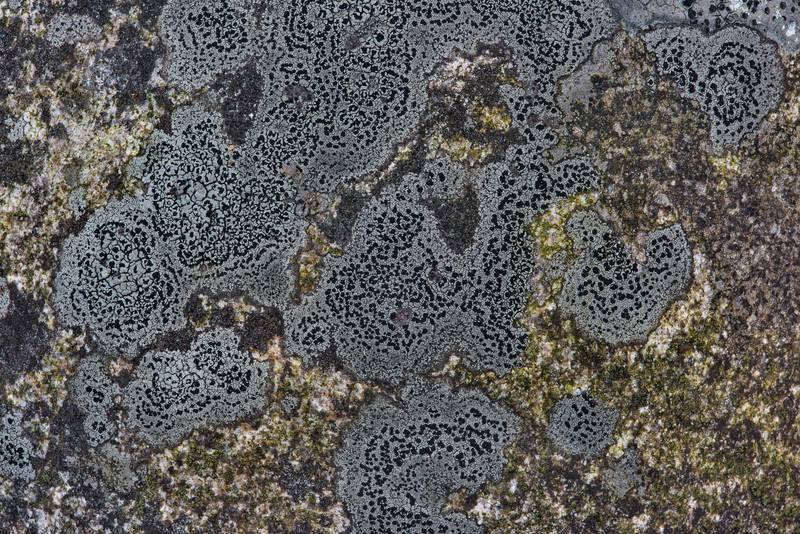

Map lichen Rhizocarpon petraeum on the surface of a rock in Zakhodskoe, 50 miles north from St.Petersburg. Russia


Album 1851: Zakhodskoe, Russia, July 10, 2016
The image depicts a close-up view of a rock's surface, characterized by its grayish hue and intricate patterns created by lichen growth. The dominant feature is the map lichen Rhizocarpon petraeum, which forms irregular patches across the rock's surface. These patches display a range of shades from light to dark gray, with some areas appearing almost white due to an accumulation of spores.
The rock itself exhibits a rough texture, evident in the way it contrasts with the smoothness of the lichen growths. The overall appearance suggests that the rock has been weathered over time, likely by exposure to wind and water.
In terms of context, the image was captured in Zakhodskoe, Russia, approximately 50 miles north of Saint Petersburg, on July 10, 2016. This location is situated in a region known for its diverse geological formations and unique ecosystems. The presence of map lichen on this particular rock indicates that it has been exposed to the elements for an extended period, allowing the lichen to establish itself as a symbiotic partner with the rock.
The image provides valuable insights into the complex relationships between rocks, lichens, and their environment. It highlights the importance of these microorganisms in shaping our understanding of geological processes and the interconnectedness of ecosystems. – AI vision
🇷🇺 Описание по-русски / Russian Description
На скале в Заходском, в 80 км к северу от Санкт-Петербурга. Россия, 10 июля 2016 г. Этот снимок делает близкий план поверхности камня, которая выделяется своей серым оттенком и сложным узором, созданным приростом лишайника. На нем заметно, что преобладающим элементом является мелкомасленник карточного размера Rhizocarpon petraeum, образующий неравномерные пятна на поверхности камня. Эти пятна демонстрируют оттенки от светло-серого до темно-серого цвета, а в некоторых местах они выглядят практически белыми из-за скопления спор. Сам камень характеризуется шероховатой текстурой, которая заметна на контрасте с гладкими образованиями лишайника. Общий вид дает понять, что этот камень был подвержен воздействию природных условий в течение длительного времени, скорее всего из-за непосредственного контакта с ветром и водой. Это место расположено в Заходском, что к северу от Санкт-Петербурга, примерно в 80 км. Снимок был сделан 10 июля 2016 года. Расположение известно своими уникальными экосистемами и геологическими формированиями. Наличие на этом конкретном камне лишайника карточного размера Rhizocarpon petraeum говорит о том, что он находится под открытым небом длительное время, что позволило ему стать симбиотическим партнером скалы. Снимок дает ценную информацию относительно сложных взаимоотношений между камнями и лишайниками и их окружающей средой. Он подчеркивает значимость этих микроорганизмов для понимания геологических процессов и связанности экосистем. – Russian translation