
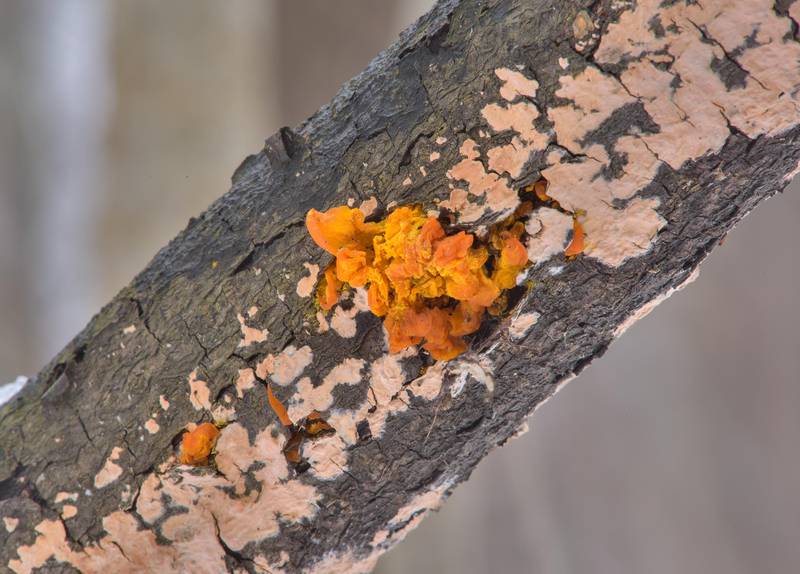

Golden jelly fungus (Tremella mesenterica) parasitizing on rosy crust mushrooms (Peniophora incarnata) in Udelny Park. St.Petersburg, Russia


Album 1993: Udelny Park in Saint Petersburg, Russia, February 28, 2017
The image depicts a close-up view of a branch with orange fungus growing from it. The branch is positioned diagonally across the frame and appears to be made of wood, likely a tree or shrub. It has a rough texture and is covered in dark brown bark.
On one side of the branch, there are several small, bright orange growths that resemble mushrooms. They have irregularly shaped caps and stems, with some of them appearing to have already fallen off the branch. The fungus appears to be growing from the surface of the bark, rather than beneath it.
The background of the image is out of focus, but it appears to be a natural environment such as a forest or woodland area. There are no other objects visible in the background that would provide context for the scene.
Overall, the image suggests that the fungus is parasitizing on the branch, possibly using it as a food source or shelter. The bright orange color of the fungus stands out against the duller tones of the bark and background, making it easy to spot even from a distance.
The fact that the fungus appears to be growing directly from the surface of the bark suggests that it may have been recently attached or has quickly spread across the area. This could indicate that the fungus is highly adaptable and able to colonize new surfaces quickly.
In terms of the species involved, the caption identifies the golden jelly fungus (Tremella mesenterica) as the parasite and the rosy crust mushrooms (Peniophora incarnata) as its host. However, without further information or expert analysis, it is difficult to determine the exact relationship between these two organisms or what specific characteristics of their interaction are being highlighted in this image.
Overall, the image provides a fascinating glimpse into the complex relationships between different species in an ecosystem and highlights the importance of studying these interactions to better understand how they contribute to the health and diversity of natural environments. – AI vision
🇷🇺 Описание по-русски / Russian Description
Гриб золотистая желе (Tremella mesenterica), паразитирующий на розовом порошке (Peniophora incarnata) в Удельном парке. Санкт-Петербург, Россия, 28 февраля 2017 года. На изображении показан крупный план ветки с оранжевым грибом, растущим на ней. Ветвь расположена по диагонали через кадр и выглядит как дерево или куст. У нее грубая текстура и темно-коричневая кора. С одной стороны ветви есть несколько маленьких, ярко-оранжевых наростов, которые похожи на грибы. У них нерегулярные крышки и стебли, а некоторые из них, кажется, уже упали с ветки. Гриб растет с поверхности коры, а не под ней. На заднем фоне изображения размыто, но он выглядит как естественная среда, такая как лес или лесополоса. На заднем фоне других видимых объектов, которые бы дали контекст для картинки, нет. В целом, изображение предполагает, что гриб паразитирует на ветке, возможно, используя ее как источник пищи или укрытие. Ярко-оранжевый цвет гриба выделяется на фоне более тусклых оттенков коры и заднего плана, что позволяет легко обнаружить его даже издалека. Тот факт, что гриб растет непосредственно с поверхности коры, предполагает, что он может быть недавно прикреплен или быстро распространился по этой области. Это могло бы указывать на то, что гриб легко адаптируется и способен быстро колонизировать новые поверхности. С точки зрения видов, подпись определяет гриб золотистая желе (Tremella mesenterica) как паразита и розовый порошок (Peniophora incarnata) как его хозяина. Однако без дополнительной информации или экспертного анализа трудно определить точную связь между этими двумя организмами или какие-то конкретные характеристики их взаимодействия показаны на этом изображении. В целом, изображение дает увлекательный проблеск сложных отношений между разными видами экосистемы и подчеркивает важность изучения этих взаимодействий, чтобы лучше понимать как они способствуют здоровью и многообразию природной среды. – Russian translation


