
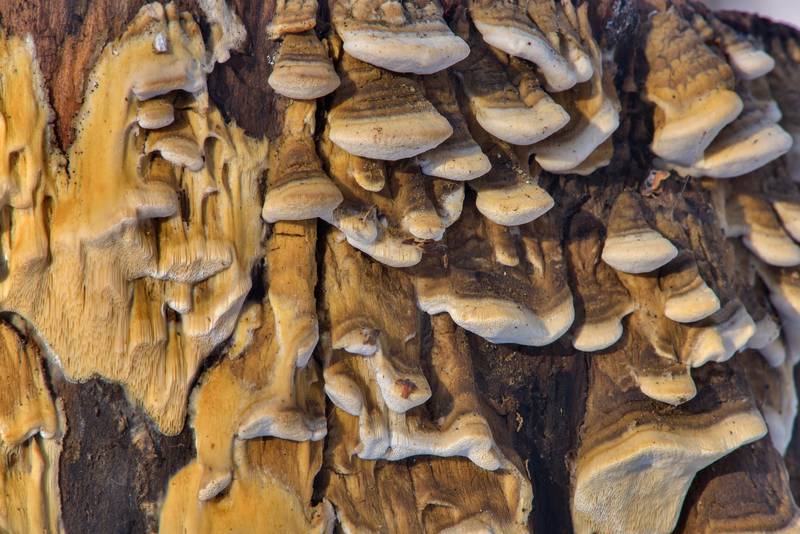

Rare tinder mushrooms Flavidoporia pulvinascens (Antrodia pulvinascens) forming stalactite like structure called pseudopilei on a stump near northern road in Yuntolovsky Park. St.Petersburg, Russia


Album 1994: Saint Petersburg, Russia, February 28 - March 1, 2017
The image features a close-up view of a rare type of mushroom known as Flavidoporia pulvinascens (Antrodia pulvinascens). These mushrooms are distinguished by their unique growth pattern, where they form "stalactite-like" structures called pseudopilei on the surface of tree trunks. In this specific instance, the mushrooms have attached themselves to a stump situated near the northern road in Yuntolovsky Park, Saint Petersburg, Russia.
The mushrooms exhibit a light yellowish-brown hue, with some displaying darker brown or black patches. The texture appears rough and irregular, consistent with the characteristics of tinder mushrooms. Notably, they are growing in a layered formation on the stump, with individual mushrooms stacked upon one another to form the stalactite-like structure.
The overall appearance of the image suggests that the photograph was taken during late winter or early spring, as indicated by the caption's mention of March 1st. The lighting is soft and diffused, likely due to overcast skies, which helps to accentuate the details of the mushrooms' texture and coloration. Overall, the image provides a fascinating glimpse into the intricate world of fungi and their ability to adapt and thrive in various environments. – AI vision
🇷🇺 Описание по-русски / Russian Description
Редкие тляпиковые грибы Flavidoporia pulvinascens (Antrodia pulvinascens) образуют на стволе неподалёку от северной дороги в Юнтоловском парке Санкт-Петербурга (Россия), 1 марта 2017 года. На снимке изображена крупным планом редкий вид гриба, известный как Flavidoporia pulvinascens (Antrodia pulvinascens). Эти грибы отличаются уникальной моделью роста, по которой они образуют на поверхности стволов «ставрообразные» образования, называемые псевдопилеи. В этом конкретном случае грибы прикрепились к сплавленному неподалёку от северной дороги в Юнтоловском парке Санкт-Петербурга (Россия) гниющему стволу, которые проявляют светло-жёлтышко-коричневый цвет, а некоторые - тёмно-коричневые или чёрные пятна. Текстура выглядит грубой и нерегулярной, что характерно для грибов-травоукладчиков. Примечательно, что они растут в слоистом строении на сплавленном дереве, а отдельные грибы слабают друг на друге, чтобы сформировать «ставрообразное» образование. В целом внешний вид изображения позволяет предположить, что фотография была сделана поздней осенью или ранней весной, о чём упоминается в подписи к 1 марта. Освещение мягкое и рассеянное, что обычно присуще облачным небесам, что помогает акцентировать детали текстуры и окраски грибов. В общем, изображение даёт удивительный шанс заглянуть в тонкий мир грибов и их способность приспосабливаться и процветать в различных средах. – Russian translation


