
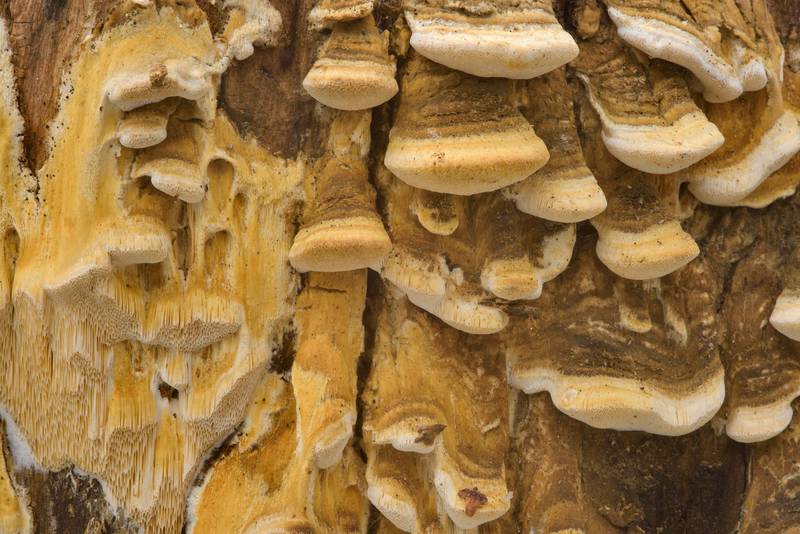

Tinder mushroom Flavidoporia pulvinascens (Antrodia pulvinascens) in northern part of Yuntolovsky Park. St.Petersburg, Russia


Album 2001: Saint Petersburg, Russia, March 9 - 11, 2017
The image presents a close-up view of the underside of a tree trunk, showcasing the growth of Tinder mushroom Flavidoporia pulvinascens (Antrodia pulvinascens) in Yuntolovsky Park, Saint Petersburg, Russia.
* **Tree Trunk:**
* The tree trunk is the primary focus of the image.
* It appears to be a deciduous tree, likely oak or maple based on the bark pattern and texture.
* The trunk's surface features visible growth rings, indicating its age.
* A small crack runs vertically along the left side of the trunk, possibly caused by weathering or decay.
* **Tinder Mushroom (Flavidoporia pulvinascens):**
* The mushroom is characterized by its bright yellow to orange color with a white base and brownish edges.
* It has a rounded cap that is roughly 1-2 cm in diameter, attached to the trunk via a short stalk.
* The gills are crowded and decurrent, meaning they run down the stem.
* The mushroom's growth pattern suggests it may be fruiting in response to environmental factors such as moisture or temperature changes.
* **Growth Pattern:**
* Multiple mushrooms are visible growing from the same area of the trunk, indicating a cluster of fruiting bodies.
* Some mushrooms appear to be overlapping or touching each other, which could be due to their growth rate or the density of spores in the environment.
* The overall pattern suggests that the mushroom is colonizing a specific area of the tree trunk.
* **Environmental Context:**
* The image was taken on March 9, 2017, which suggests that the mushrooms were observed during early spring when temperatures are rising after winter dormancy.
* The presence of multiple mushrooms growing from the same area implies that the environment is conducive to their growth, possibly due to adequate moisture and nutrients.
In summary, the image provides a detailed view of the underside of a tree trunk in Yuntolovsky Park, Saint Petersburg, Russia, showcasing the growth of Tinder mushroom Flavidoporia pulvinascens. The mushroom's bright yellow color and rounded cap distinguish it from other species, while its growth pattern suggests a response to environmental factors such as moisture or temperature changes. – AI vision
🇷🇺 Описание по-русски / Russian Description
На тропе в северной части парка Юнтолово. Санкт-Петербург, Россия, 9 марта 2017 года. Эта фотография показывает подробный вид с нижней стороны ствола дерева и рост гриба Flavidoporia pulvinascens (Antrodia pulvinascens). * **Деревья**: * Главным объектом на изображении является ствол дерева. * Ствол, скорее всего, листопадного дерева, возможно, дуба или клена по внешним признакам коры и текстуре. * На поверхности ствола видны годичные слои, которые указывают на его возраст. * По левой стороне ствола вертикально проходит небольшая трещина, возможно, вызванная воздействием погоды или гниением. * **Гриб Flavidoporia pulvinascens (Tinder гриб):* * Этот гриб характеризуется ярко-желтым, оранжевым цветом с белой основой и коричневыми краями. * Шляпка округлая, примерно 1–2 см в диаметре, крепится к стволу небольшим черенком. * Пластинки переполнены и нисходящие, т. е. направлены вниз по стволу. * Фруктовый теле гриба развивается в ответ на изменения окружающей среды, такие как влажность или температура. * **Схема роста**: * На изображении видны несколько фруктовых тел, растущих с одной области ствола, что указывает на скопление плодовых тел. * Некоторые грибы накладываются или перекрывают друг друга, возможно, из-за их темпов роста или высокой концентрации спор в окружающей среде. * Общая схема роста позволяет предположить, что гриб колонизирует определенную область ствола дерева. * **Контекст окружающей среды**: * Эта фотография была сделана 9 марта 2017 года, когда наблюдались ранние весенние температуры после зимнего покоя. * Наличие нескольких фруктовых тел в одной области ствола указывает на благоприятные для роста условия в окружающей среде, возможно, из-за достаточной влажности и питательных веществ. В целом, эта фотография позволяет подробно рассмотреть нижнюю сторону ствола дерева в парке Юнтолово в Санкт-Петербурге, Россия, демонстрируя рост гриба Flavidoporia pulvinascens. Яркий желтый или оранжевый цвет и округлая шляпка отличают гриб от других видов, в то время как его схема роста свидетельствует об ответе на изменения окружающей среды. – Russian translation


