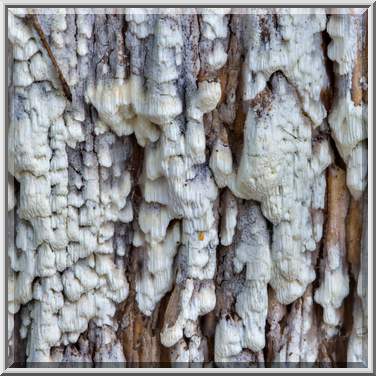

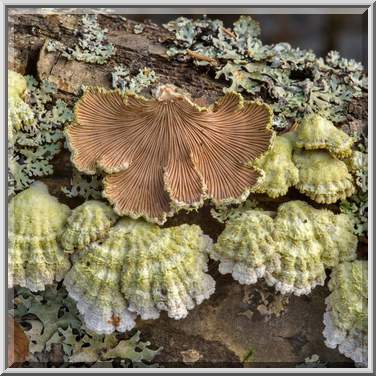
Split gill fungus Schizophyllum commune on a fallen willow tree near Kavgolovskoe Lake in Toksovo, north from St.Petersburg. Russia


Album 2004: Toksovo, Russia, March 14, 2017
The image presents a close-up view of a fallen willow tree trunk, featuring an abundance of Split gill fungus (Schizophyllum commune). The tree's bark is dark brown and weathered, with numerous cracks and crevices that provide a habitat for various organisms.
The most striking aspect of the image is the extensive growth of Split gill fungus on the tree trunk. This type of fungus belongs to the family Schizophyllaceae and has a distinctive appearance, characterized by its fan-shaped or semicircular fruiting bodies that are typically white or light-colored when young. As they mature, these fruiting bodies often develop a wavy or lobed margin.
In this image, the Split gill fungus is visible in various stages of growth, ranging from small, immature structures to larger, more developed ones. Some of the fungus's fruiting bodies appear to be clustered together, forming dense groups that cover significant areas of the tree trunk. This clustering may be due to factors such as moisture levels, temperature fluctuations, or competition for nutrients.
Beyond the Split gill fungus, other organisms can be observed on the tree trunk. Small patches of lichen are visible in some areas, adding a touch of greenery to the otherwise brown and weathered surface. Lichens are composite organisms consisting of fungi and algae or cyanobacteria living together in symbiosis. They play an important role in ecosystems by providing food for insects and other small animals.
The background of the image is not clearly visible due to the close-up nature of the photograph. However, it can be inferred that the tree trunk lies on a forest floor or near a body of water, given the presence of nearby vegetation and the fact that the willow tree appears to have been felled relatively recently.
Overall, the image provides a detailed look at the complex relationships between different organisms in an ecosystem. The Split gill fungus is just one component of this web of life, interacting with other microorganisms, insects, and plants to create a thriving community. – AI vision
🇷🇺 Описание по-русски / Russian Description
На стволе ивы около озера Кавголовского в Токсово, севернее Санкт-Петербурга. Россия, 14 марта 2017 года. На изображении присутствует крупный план ствола павшего дерева и его обилие гриба Schizophyllum commune. Кора на стволе имеет темно-коричневый цвет, и по ней можно увидеть многочисленные трещины и щели, которые служат местом обитания для разных организмов. Наиболее впечатляющим элементом изображения является широкое распространение гриба Schizophyllum commune на стволе дерева. Этот вид относится к семейству Schizophyllaceae и имеет отличительный облик с роговым рисунком или полукруглыми фруктовыми телами, которые в молодом возрасте имеют белый или светлые тона. По мере созревания этих плодовых тел они часто приобретают волнистую или расчлененную кромку. На этом изображении виден гриб Schizophyllum commune на разных стадиях развития, от маленьких неразвитых структур до более полноразмерных и зрелых. Некоторые плодовые тела этого гриба располагаются компактными группами, покрывая значительную часть ствола дерева. Вероятно, что образование этих групп вызвано такими факторами, как уровень влажности, колебания температуры и конкуренция за питательные вещества. Помимо гриба Schizophyllum commune, на стволе дерева можно наблюдать некоторых других организмов. В отдельных участках заметны маленькие пятна лишайника, добавляющие зеленую краску к иному коричневому и потертому фону. Лишайники – сложные организмы, состоящие из грибов и водорослей или цианобактерий в симбиозе. Они играют важную роль в экосистемах, служа пищей для насекомых и других мелких животных. На заднем плане изображения не видно по причине близкого расположения камеры. Однако можно догадаться, что ствол лежит на лесном грунте или возле водоема с учетом присутствия рядом растительности и того факта, что ива была срублена относительно недавно. В целом, изображение предоставляет подробное представление о сложных взаимосвязях между разными организмами в экосистеме. Гриб Schizophyllum commune является всего лишь одним компонентом этой сети жизни, взаимодействующим с другими микроорганизмами, насекомыми и растениями для создания процветающего сообщества. – Russian translation


