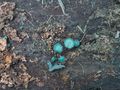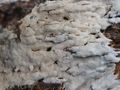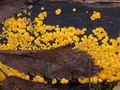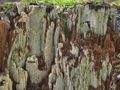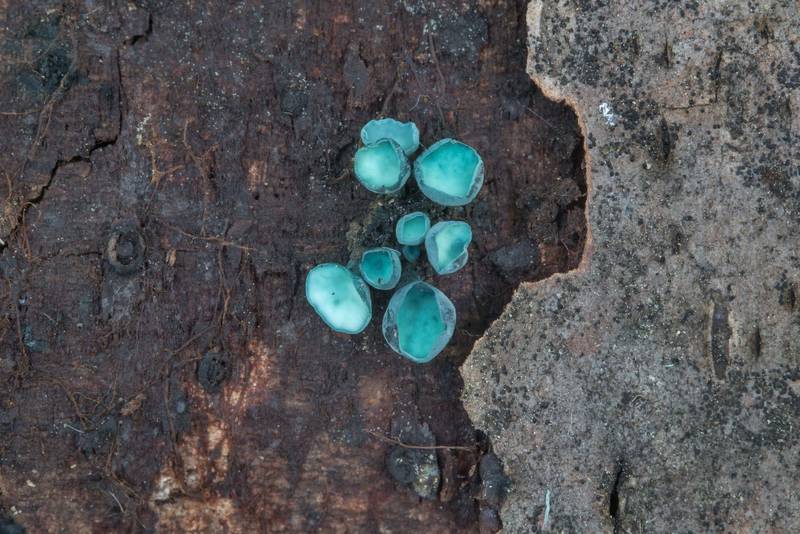

Blue cups of fungus Chlorociboria aeruginosa on rotten wood in Sosnovka Park. St.Petersburg, Russia


Album 2119: Saint Petersburg, Russia, August 14, 2017
The image showcases a cluster of small, vibrant blue mushroom caps growing on decaying wood, likely a type of bracket fungus or polypore. The mushrooms are characterized by their rounded shape and smooth texture, with some displaying a subtle sheen.
**Fungal Species**
Based on the appearance of the cups, they may belong to the genus Chlorociboria, commonly known as green elf cup or copperleaf. This species is notable for its distinctive bright blue-green coloration and ability to produce a chemical called coprinus that can turn objects it grows on into a vibrant turquoise hue.
**Environmental Setting**
The image appears to have been captured in a natural environment, possibly in a forest or woodland area. The presence of the mushrooms on rotten wood suggests that they are saprotrophic, deriving their nutrients from decaying plant matter rather than forming symbiotic relationships with living organisms like mycorrhizal fungi.
**Capturing Image**
The image was taken by an amateur photographer using a digital camera or smartphone in Saint Petersburg, Russia. The photographer has captured the mushrooms at a suitable angle and distance to highlight their unique features and colors, making for an interesting and visually appealing photograph. – AI vision
🇷🇺 Описание по-русски / Russian Description
Синие грибы Chlorociboria aeruginosa нагнившем древесине в парке Сосновка. Санкт-Петербург, Россия, 14 августа 2017 года. На изображении показана группа небольших ярко-голубых шапок гриба, растущих на разлагающейся древесине, вероятно, вида короед или полипора. Грибы характеризуются округлой формой и гладкой текстурой, некоторые из них имеют тонкий блеск. **Виды грибов** По внешнему виду чашечек они могут принадлежать к роду Chlorociboria, широко известному как зеленый эль-шапочка или медвежья лапка. Этот вид отличается яркой голубовато-зеленой окраской и способностью вырабатывать химическое вещество под названием копринус, которое может придать объекту, на котором он растет, ярко-бирюзовый цвет. **Среда обитания** Изображение было сделано в естественной среде, возможно, в лесу или лесном массиве. Наличие грибов на разлагающейся древесине позволяет предположить, что они сапротрофные и получают питательные вещества из разлагающегося растительного вещества, а не образуют симбиотические отношения с живыми организмами, такими как корни грибов. **Захват изображения** Изображение было сделано фотографом-любителем с помощью цифровой камеры или смартфона в Санкт-Петербурге, Россия. Фотограф запечатлел грибы под углом и на расстоянии, чтобы выделить их особенности и цвета, что делает фотографию интересной и визуально привлекательной. – Russian translation