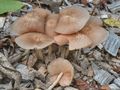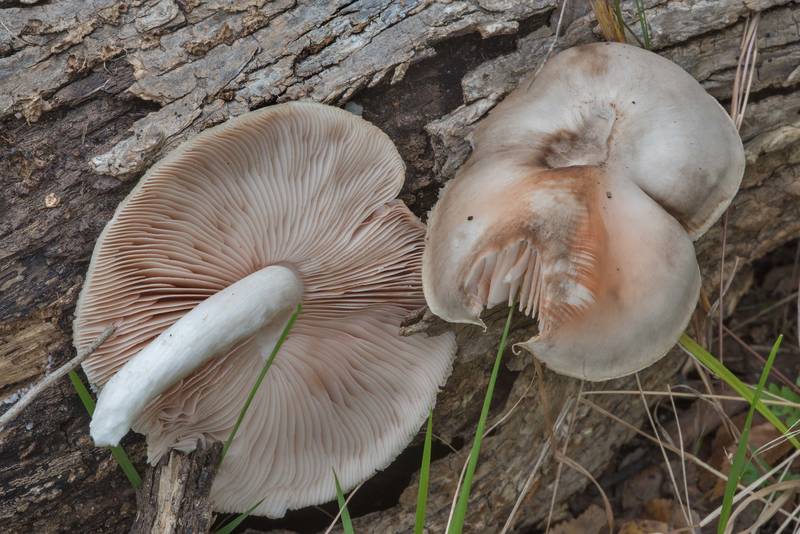

Pluteus mushrooms on a log in Bee Creek Park. College Station, Texas


Album 2196: College Station, Texas, November 8 - 9, 2017
The image shows a close-up view of three Pluteus mushrooms growing on the side of a fallen tree trunk or log. The largest mushroom is positioned centrally and has a light brown cap with fine radial grooves and a pale white gill edge that runs from the base to the top of the cap. The gills are closely packed, thin, and pinkish in color. A small twig lies across the lower half of the mushroom's cap.
To the right of the largest mushroom is another Pluteus mushroom with a smaller cap. It has brown radial grooves similar to its larger counterpart, but they are less pronounced. The gills on this mushroom appear more vibrant and pinkish than those on the central mushroom, possibly due to age or moisture levels.
In the lower left corner of the image, there is a third Pluteus mushroom with a light brown cap featuring fine radial grooves similar to its counterparts. However, this mushroom's cap appears slightly less dense and has a more pronounced white edge where it meets the gills.
The background of the image shows the rough bark of the fallen tree trunk or log, which provides a natural habitat for these fungi. A small patch of green grass is visible at the bottom of the image, adding to the overall sense of an outdoor environment. – AI vision
🇪🇸 Descripción en español / Spanish Description
Hongos Pluteus en un tronco caído en Bee Creek Park. College Station, Texas, 8 de noviembre de 2017. La imagen muestra una vista detallada de tres hongos Pluteus que crecen en el lado de un tronco o leña caída. El hongo más grande está ubicado en posición central y tiene una cubierta marrón claro con surcos radiales finos y un borde de las plicas blanco pálido que discurre desde la base hasta la parte superior de la cubierta. Las plicas están empaquetadas de cerca, delgadas y de color rosado. Un pequeño ramito se encuentra a lo largo de la mitad inferior de la cubierta del hongo. A la derecha del hongo más grande hay otro hongo Pluteus con una tapa más pequeña. Tiene surcos radiales marrones similares a su homólogo más grande, pero están menos pronunciados. Las plicas en este hongo parecen más vibrantes y rosadas que las del hongo central, posiblemente debido a la edad o al nivel de humedad. En el ángulo inferior izquierdo de la imagen hay un tercer hongo Pluteus con una tapa marrón claro que presenta surcos radiales similares a sus homólogos. Sin embargo, la cubierta del hongo parece ligeramente menos densa y tiene un borde blanco más pronunciado donde se encuentran las plicas. El fondo de la imagen muestra la corteza áspera del tronco o leña caída, que proporciona un hábitat natural para estos hongos. Un pequeño parche de hierba verde es visible en la parte inferior de la imagen, lo que aumenta la sensación general de un entorno al aire libre. – Spanish translation