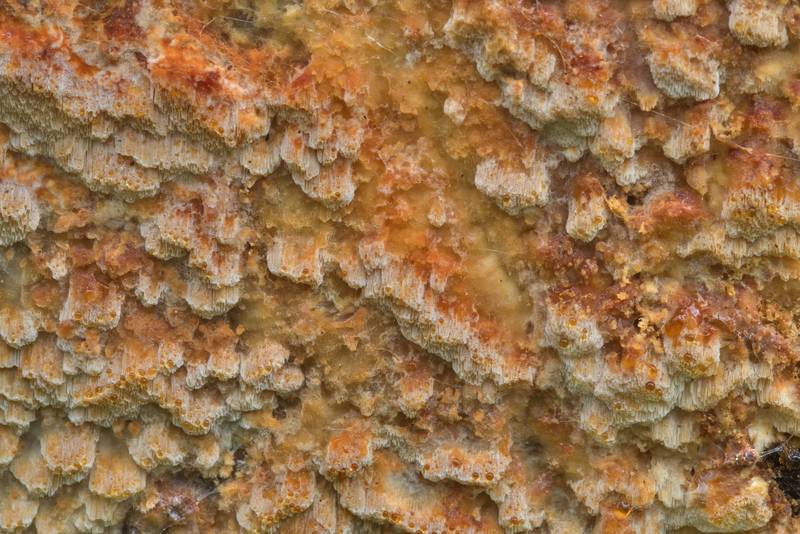
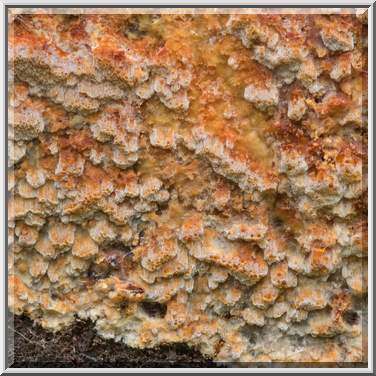
Tinder mushroom Physisporinus on a cut surface of a pine log on Caney Creek Trail (Little Lake Creek Loop Trail) in Sam Houston National Forest, near Huntsville. Texas


Album 2234: Bryan - Sam Houston Forest, Texas, March 8 - 10, 2018
The image depicts the underside of a pine tree trunk, which has been cut and is now displaying its inner structure. The surface is covered with numerous small, rounded, light brown to yellowish-orange growths that resemble fungal fruiting bodies or conks.
These growths are likely produced by Physisporinus spp., commonly known as tinder mushrooms due to their use as tinder for starting fires. They are typically found growing on decaying wood and can be a sign of the presence of other fungi, including those capable of breaking down complex organic molecules in soil.
The colors present in the image suggest that this is an older growth, possibly from last year's fruiting season or earlier, with some areas showing signs of decay or rot. The overall appearance of the tree trunk and its underside suggests it may have been cut recently, but not within the past few weeks or months.
Overall, the image provides a detailed view of the inner structure of a pine tree trunk, highlighting the unique features of Physisporinus spp. growths and their potential role in decomposition processes in forest ecosystems. – AI vision
🇪🇸 Descripción en español / Spanish Description
Hongo Tinder de la especie Physisporinus sobre una superficie cortada de un tronco de pino en el Caney Creek Trail (Little Lake Creek Loop Trail) en la Selva Nacional Sam Houston, cerca de Huntsville, Texas, el 10 de marzo de 2018. La imagen muestra la parte inferior del tronco de un árbol de pino, que ha sido cortado y ahora se puede ver su estructura interna. La superficie está cubierta con numerosas protuberancias pequeñas redondeadas, marrones claros a naranja amarillento, que recuerdan a cuerpos fructíferos o pudrición de hongos. Es probable que estos crecimientos sean producidos por Physisporinus spp., comúnmente conocido como hongos tintero debido a su uso como mechero para encender fuegos. Se encuentran normalmente en madera en descomposición y pueden ser un signo de la presencia de otros hongos, incluidos los capaces de romper moléculas orgánicas complejas en el suelo. Los colores presentes en la imagen sugieren que este es un crecimiento más antiguo, posiblemente desde la temporada de frutificación del año pasado o antes, con algunas áreas mostrando signos de descomposición o podredumbre. El aspecto general del tronco y su parte inferior sugiere que puede haber sido cortado recientemente, pero no en las últimas semanas u meses. En general, la imagen proporciona una vista detallada de la estructura interna de un tronco de árbol de pino, destacando las características únicas del crecimiento de Physisporinus spp. Y su potencial papel en los procesos de descomposición en los ecosistemas forestales. – Spanish translation