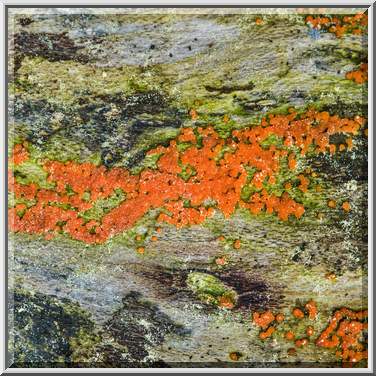
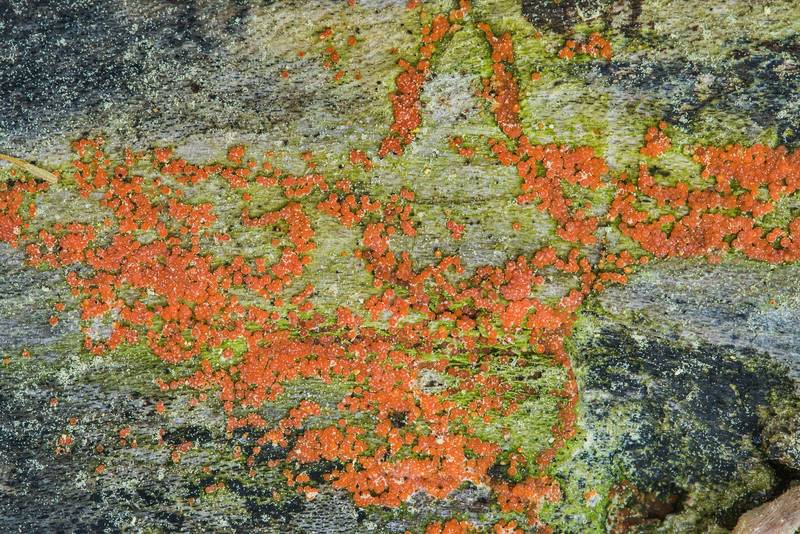
Yellow Spot mushrooms (Nectria peziza)(?) on a wood on Caney Creek Trail (Little Lake Creek Loop Trail) in Sam Houston National Forest, near Huntsville. Texas


Album 2234: Bryan - Sam Houston Forest, Texas, March 8 - 10, 2018
The provided image showcases an image of orange fungi growing on a piece of rotting wood. The fungi appear to be clustered in small groups and are visible in several areas within the image. This clustering pattern is typical for many species of fungi, which often grow in dense clusters.
The wood itself appears to be decaying, with cracks and crevices visible throughout its surface. It has likely been weathered by exposure to elements such as rain and sunlight over time. The color of the wood ranges from light tan at the top left corner to dark brown near the bottom right, indicating that it is made up of different types of wood or has undergone some form of weathering.
There are also visible green patches on the image. These could be mosses, lichens, algae, or other organisms growing on the decaying wood. They can indicate the presence of moisture and nutrients in the environment. The green patches are scattered throughout the image, with some areas having a higher concentration than others.
Overall, this image presents a detailed view of a piece of rotting wood covered in fungi and other organic matter. It suggests that the wood has been exposed to various environmental factors over time, resulting in its current state. – AI vision
🇪🇸 Descripción en español / Spanish Description
Los hongos de la mancha amarilla (Nectria peziza)(?) en una madera del camino Caney Creek (Little Lake Creek Loop Trail) en el bosque nacional Sam Houston, cerca de Huntsville. Texas, 10 de marzo de 2018. La imagen proporcionada muestra una imagen de hongos naranjas que crecen en un trozo de madera podrida. Los hongos parecen estar agrupados en pequeños grupos y son visibles en varias áreas dentro de la imagen. Este patrón de agrupamiento es típico para muchas especies de hongos, que a menudo crecen en densas agrupaciones. La madera misma parece estar podrida, con grietas y hendiduras visibles en toda su superficie. Es probable que haya sido erosionada por la exposición a elementos como la lluvia y la luz solar con el tiempo. El color de la madera varía desde el color tostado superior izquierdo hasta el marrón oscuro cerca del lado derecho inferior, lo que indica que está compuesto por diferentes tipos de madera o ha sufrido algún tipo de intemperismo. También se pueden ver parches verdes en la imagen. Estos podrían ser musgos, líquenes, algas u otros organismos que crecen sobre la madera podrida. Pueden indicar la presencia de humedad y nutrientes en el entorno. Los parches verdes están dispersos por toda la imagen, con algunas áreas teniendo una concentración más alta que otras. En general, esta imagen presenta una vista detallada de un trozo de madera podrida cubierta de hongos y otra materia orgánica. Sugiere que la madera ha estado expuesta a varios factores ambientales con el tiempo, dando como resultado su estado actual. – Spanish translation


