
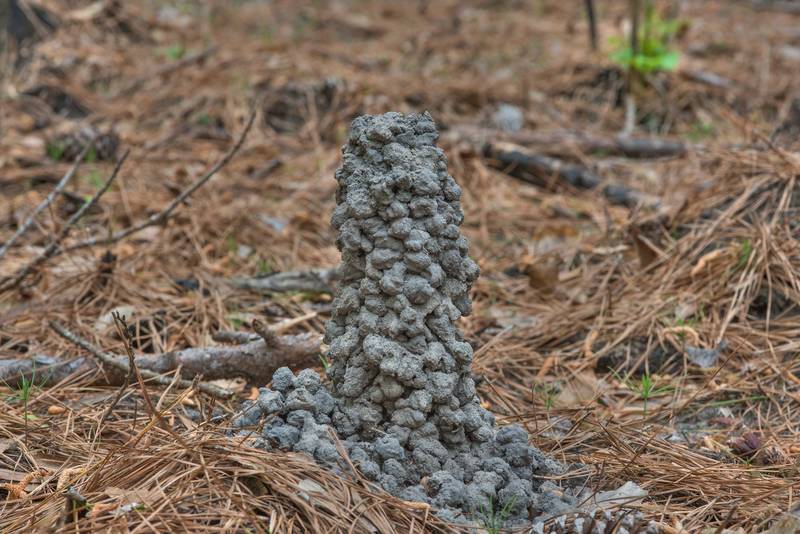
Mud chimney borrowed by crayfish (crawfish) on Caney Creek section of Lone Star Hiking Trail in Sam Houston National Forest near Huntsville, Texas


Album 2238: Sam Houston Forest, Texas, March 24, 2018
The image presents a close-up view of a mud chimney constructed by crayfish (crawfish) on Caney Creek, situated within the Lone Star Hiking Trail in Sam Houston National Forest near Huntsville, Texas. The photograph was taken on March 24, 2018.
**Mud Chimney**
* Constructed from grayish-brown clay-like mud
* Comprises rounded balls of mud stacked vertically to form a tall column
* Approximately 6-7 inches (15-18 cm) in height
**Surrounding Environment**
* Scattered pine needles cover the ground around the mud chimney
* A few sticks are visible near the base of the structure, possibly used by crayfish as part of their construction process or serving as a foundation for the mound
**Crayfish Activity**
The presence of this mud chimney suggests that crayfish have been actively building and maintaining these structures in the area. Crayfish use mud chimneys to create burrows and shelter themselves from predators, while also providing a means of escape during flooding events.
**Background and Context**
* The image captures a small but significant aspect of the ecosystem within Sam Houston National Forest
* The forest is home to diverse wildlife, including various species of crayfish, fish, birds, and mammals. – AI vision
🇪🇸 Descripción en español / Spanish Description
El chimenea de barro construida por un cangrejo de río (cangrejo de agua) en la sección Caney Creek del Lone Star Hiking Trail en el bosque nacional Sam Houston cerca de Huntsville, Texas, el 24 de marzo de 2018. La imagen muestra una vista detallada de un chimenea de barro construida por cangrejos de río (cangrejo de agua) en Caney Creek, situado dentro del Lone Star Hiking Trail en el bosque nacional Sam Houston cerca de Huntsville, Texas. La fotografía fue tomada el 24 de marzo de 2018. **Chimenea de barro** *Construida a partir de arcilla grisácea-marrón*Comprende bolas redondeadas de barro apiladas verticalmente para formar una columna alta*De aproximadamente 6-7 pulgadas (15-18 cm) de altura**Entorno circundante:*Hay hojas de pino dispersas cubriendo el suelo alrededor del chimenea de barro*Se ven unos pocos palitos cerca de la base de la estructura, posiblemente utilizados por los cangrejos de río como parte de su proceso constructivo o que sirven de cimiento para el montículo**Actividad de los cangrejos de río:*La presencia de esta chimenea de barro sugiere que los cangrejos de río han estado construyendo y manteniendo activamente estas estructuras en la zona. Los cangrejos de río usan las chimeneas de barro para crear madrigueras y refugiarse de los depredadores, además de proporcionarles un medio de escape durante las inundaciones.**Fondo y contexto:*La imagen captura un aspecto pequeño pero significativo del ecosistema dentro del bosque nacional Sam Houston*El bosque es hogar de diversos animales silvestres, incluidas diferentes especies de cangrejos de río, peces, aves y mamíferos. – Spanish translation


