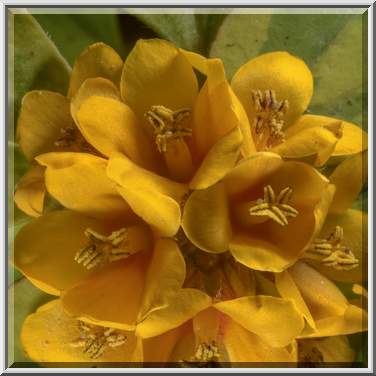
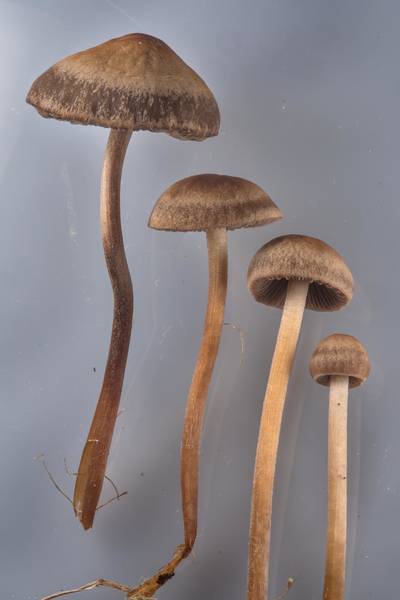
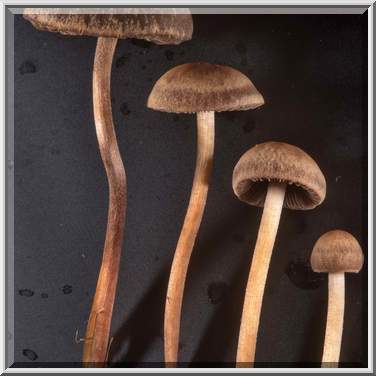
Banded mottlegill mushrooms (Panaeolus cinctulus) taken from grassy area at crossing of New Main Dr. and Texas Ave. on campus of Texas A&M University. College Station, Texas


Album 2254: Washington-on-the-Brazos - College Station, Texas, May 2 - 4, 2018
The image features four mushrooms with varying heights, arranged from left to right: the tallest mushroom is approximately two-thirds of the full height of the image, while the shortest mushroom takes up a quarter of the total height. The first mushroom has a long stem and a relatively small cap that tapers towards the top. In contrast, the second mushroom boasts a slightly larger cap with more pronounced ridges than the first.
The third mushroom also features a large cap but lacks the tapering effect seen in the first mushroom. Interestingly, its stem is not as long as the first mushroom's, although it is still taller than the fourth mushroom. The latter has a short stem and a small cap that appears to be roughly the same size as those of the other two smaller mushrooms.
The caps exhibit varying degrees of coloration, ranging from brown to tan or beige hues, with some displaying more pronounced ridges than others. The stems are primarily composed of light-colored wood-like material, possibly originating from decaying tree stumps or logs, which would explain their wooden appearance.
Overall, the image showcases a diverse selection of mushrooms growing in close proximity to one another, each with unique characteristics that set them apart from the rest. – AI vision
🇪🇸 Descripción en español / Spanish Description
Los hongos moteados con anillos (Panaeolus cinctulus) recogidos de una zona herbosa en el cruce de New Main Drive y Texas Avenue en el campus de la Universidad A&M de Texas. College Station, Texas, 4 de mayo de 2018. La imagen muestra cuatro hongos con alturas variables, dispuestos de izquierda a derecha: el hongo más alto mide aproximadamente dos tercios de la altura total de la imagen, mientras que el hongo más corto ocupa un cuarto de la altura total. El primer hongo tiene un largo tallo y una cabeza relativamente pequeña que se estrecha hacia la parte superior. En contraste, el segundo hongo presenta una cabeza ligeramente más grande con aristas más pronunciadas que el primero. El tercer hongo también tiene una cabeza grande pero carece del efecto de estrechamiento visto en el primer hongo. Curiosamente, su tallo no es tan largo como el del primer hongo, aunque sigue siendo más alto que el cuarto hongo. Este último tiene un tallo corto y una cabeza pequeña que parece ser aproximadamente del mismo tamaño que las de los otros dos hongos más pequeños. Las cabezas presentan diferentes grados de coloración, que van desde marrones a tonalidades castaño o beis, mostrando algunas aristas más pronunciadas que otras. Los tallos están compuestos principalmente por material parecido a la madera de un solo color claro, originándose posiblemente en troncos o troncos en descomposición, lo cual explicaría su aspecto de madera. En general, la imagen muestra una selección variada de hongos creciendo muy cerca el uno del otro, cada uno con características únicas que los distinguen entre sí. – Spanish translation


