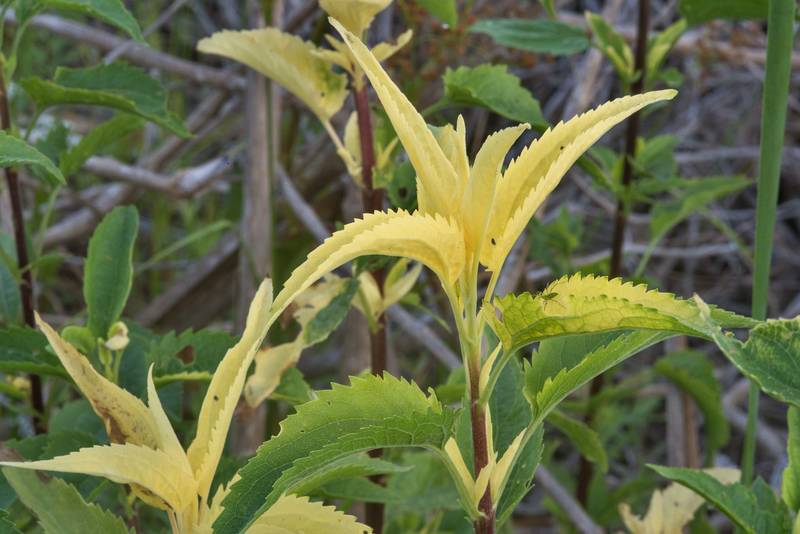

Yellow-white chlorotic leaves near the lake in Lake Bryan Park. Bryan, Texas


Album 2260: Bryan, Texas, May 16, 2018
The image presents a close-up view of yellowish-green leaves with jagged edges, set against a backdrop of variously colored stems and twigs. The leaves appear to be slightly curled, suggesting they may have been exposed to excessive moisture or humidity.
**Key Features:**
* **Leaves:** The leaves are predominantly green, but display varying degrees of yellowing, particularly towards their tips.
* **Stems and Twigs:** The stems and twigs exhibit a range of colors, including grayish-brown, brown, and tan. Some appear to be dead or dying, while others show signs of regrowth.
* **Background:** The background is not clearly visible due to the focus on the leaves and stems.
**Possible Interpretations:**
* **Environmental Factors:** The yellowing of the leaves could be attributed to environmental factors such as excessive moisture, nutrient deficiencies, or exposure to pollutants. The presence of dead or dying twigs may indicate a decline in plant health.
* **Plant Species:** Without further information, it is difficult to determine the specific plant species depicted in the image.
**Conclusion:**
Based on the visual characteristics and potential environmental factors, it can be inferred that the leaves are experiencing some form of stress or damage. However, without additional context or expert analysis, a definitive diagnosis cannot be made. – AI vision
🇪🇸 Descripción en español / Spanish Description
Las hojas amarillo-blancas se ven cloróticas cerca del lago en el Lake Bryan Park. Bryan, Texas, 16 de mayo de 2018. La imagen presenta una vista detallada de las hojas verdes amarillentas con bordes dentados, situadas frente a un fondo de vástagos y ramitas de distintos colores. Las hojas parecen estar ligeramente enrolladas, lo que sugiere que podrían haber estado expuestas a la humedad o la humedad excesiva. **Características Clave:** * **Hojas:** Las hojas son predominantemente verdes, pero presentan diversos grados de amarilleo, particularmente en sus puntas. * **Vástagos y ramitas:** Los vástagos y ramitas exhiben una variedad de colores, incluyendo marrón-grisáceo, marrón y color canela. Algunos parecen estar muertos o muriendo, mientras que otros muestran signos de rebrotes. * **Fondo:** El fondo no es claramente visible debido al enfoque en las hojas y vástagos. **Posibles Interpretaciones:** * **Factores Ambientales:** El amarilleo de las hojas podría atribuirse a factores ambientales como la humedad excesiva, deficiencias nutricionales o exposición a contaminantes. La presencia de vástagos muertos o en proceso de muerte puede indicar un declive en la salud de las plantas. * **Especies Vegetales:** Sin más información, es difícil determinar la especie vegetal representada en la imagen. **Conclusión:** En base a las características visuales y los posibles factores ambientales, se puede inferir que las hojas están experimentando algún tipo de estrés o daño. Sin embargo, sin contexto adicional ni análisis experto, no es posible hacer un diagnóstico definitivo. – Spanish translation