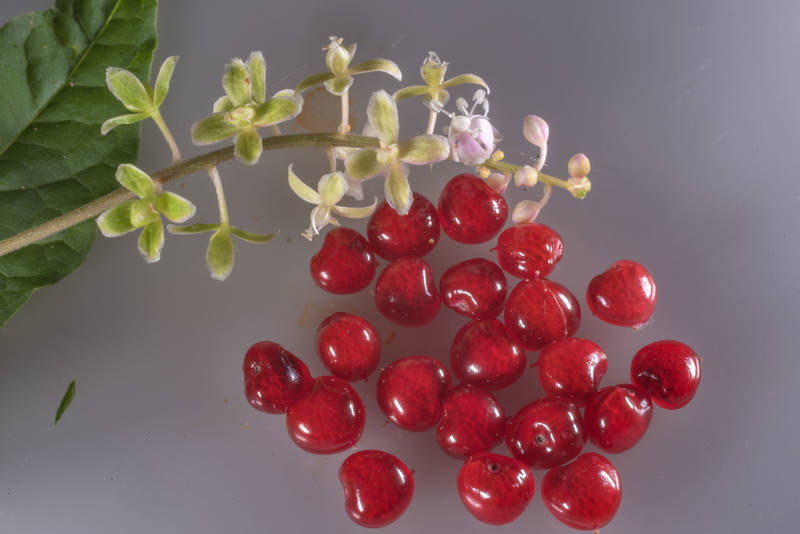

Pigeon-berry (Rivina humilis, rouge-plant, baby peppers) near a ferry site in Washington-on-the-Brazos State Historic Site. Washington, Texas


Album 2325: College Station, Texas, July 2 - 15, 2018
The image depicts a cluster of red berries with white flowers and green leaves, possibly from the Pigeon-berry plant (Rivina humilis). The berries are small, round, and shiny, ranging in color from bright red to deep crimson. They are scattered on the surface, some of which appear to be partially covered by water.
In the upper left corner of the image, a few green leaves with serrated edges can be seen. A long stem connects these leaves to the rest of the plant, which is not visible in the frame. The leaves are attached to the stem at various points, giving them a somewhat irregular appearance.
The background of the image is a grayish-brown color, suggesting that it may have been taken on a stone or wooden surface. There are no other objects or features visible in the image beyond the berries and leaves.
Overall, the image appears to be a close-up photograph of the Pigeon-berry plant's fruit and foliage. The presence of water suggests that the image may have been taken near a body of water, such as a stream or lake, where the plant is often found growing in wet environments. – AI vision
🇪🇸 Descripción en español / Spanish Description
Bayas de paloma (Rivina humilis, rouge-plant, pimientos bebés) cerca de un sitio de ferry en el Washington-on-the-Brazos State Historic Site. Washington, Texas, 5 de agosto de 2018. La imagen muestra una agrupación de bayas rojas con flores blancas y hojas verdes, posiblemente de la planta de baya de paloma (Rivina humilis). Las bayas son pequeñas, redondas y brillantes, que varían en color desde el rojo vivo hasta el rojo oscuro. Están esparcidas sobre la superficie, algunas de las cuales parecen estar parcialmente cubiertas por agua. En la esquina superior izquierda de la imagen, se pueden ver unas pocas hojas verdes con bordes serrados. Un largo tallo conecta estas hojas al resto de la planta, que no es visible en el encuadre. Las hojas están unidas al tallo en varios puntos, lo que les da un aspecto algo irregular. El fondo de la imagen tiene un color parduzco grisáceo, sugiriendo que se tomó sobre una superficie de piedra o madera. No hay otros objetos ni características visibles en la imagen aparte de las bayas y hojas. En general, la imagen parece ser una fotografía de primer plano del fruto y follaje de la planta de baya de paloma. La presencia de agua sugiere que la imagen se tomó cerca de un cuerpo de agua, como un arroyo o lago, donde a menudo se encuentra creciendo la planta en entornos húmedos. – Spanish translation