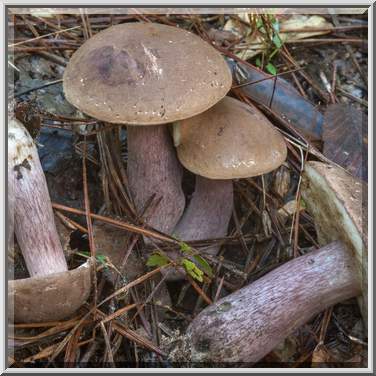
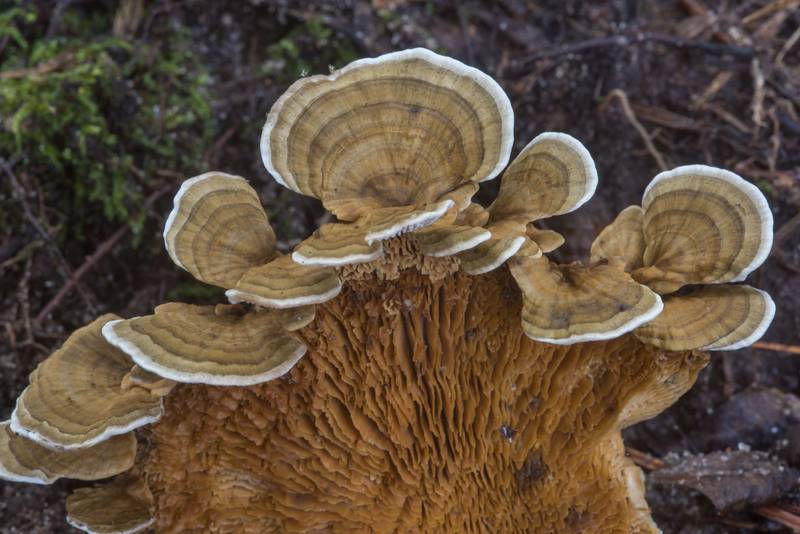

Thin-walled maze polypore mushrooms Daedaleopsis confragosa on Caney Creek section of Lone Star Hiking Trail in Sam Houston National Forest near Huntsville, Texas


Album 2355: Sam Houston Forest, Texas, September 15, 2018
The image presents a detailed close-up view of several thin-walled maze polypore mushrooms (Daedaleopsis confragosa) growing on a log or tree trunk. The mushrooms are characterized by their distinctive fan-shaped caps, which are typically 3-6 inches wide and have a smooth surface with wavy edges.
**Key Features:**
* **Mushroom Caps:** The caps of the mushrooms exhibit a range of colors, including shades of brown, tan, and beige. They often feature concentric rings or zones that radiate from the center to the edge.
* **Gills:** The underside of each cap is covered in tiny, crowded gills that are white or light-colored when young but turn darker with age.
* **Stem:** The stems of the mushrooms are short and stout, typically ranging from 1/4 to 1 inch long. They are usually pale-colored and may be slightly thicker at the base where they attach to the substrate.
* **Spore Print:** When mature, the mushrooms produce a brown spore print on their gills.
* **Habitat:** The mushrooms can be found growing in clusters or singly on decaying wood, particularly oak trees. They are often associated with other fungi and may form symbiotic relationships with their host tree.
**Interesting Facts:**
* **Edibility:** Thin-walled maze polypore mushrooms are edible but not particularly flavorful or textured.
* **Medicinal Properties:** Some species of Daedaleopsis confragosa have been used in traditional medicine to treat various ailments, including fever and rheumatism.
* **Ecological Role:** These mushrooms play a crucial role in decomposing organic matter and recycling nutrients back into the ecosystem.
In summary, the image showcases several thin-walled maze polypore mushrooms growing on a log or tree trunk. The mushrooms have distinctive fan-shaped caps with wavy edges and crowded white gills that turn brown with age. They are edible but not particularly flavorful or textured, and some species have been used in traditional medicine to treat various ailments. – AI vision
🇪🇸 Descripción en español / Spanish Description
Los hongos poliporos de mazo de pared delgada Daedaleopsis confragosa en la sección de Caney Creek del Sendero para excursionistas Lone Star en el Bosque Nacional Sam Houston cerca de Huntsville, Texas, el 15 de septiembre de 2018. La imagen presenta una vista detallada y cercana de varios hongos poliporos de mazo de pared delgada (Daedaleopsis confragosa) que crecen en un tronco o tronco de un árbol. Los hongos se caracterizan por sus distintivas sombreros en forma de abanico, que miden típicamente de 3 a 6 pulgadas de ancho y tienen una superficie lisa con bordes ondulados. **Características principales:** * **Sombreros de hongos:** Los sombreros de los hongos presentan una variedad de colores, incluidas las tonalidades marrones, beis y beige. A menudo cuentan con anillos o zonas concéntricas que parten del centro hacia el borde. * **Laminillas:** La parte inferior de cada sombrero está cubierta por pequeñas laminillas muy juntas que son de color blanco cuando son jóvenes, pero se oscurecen con el tiempo. * **Tallo:** Los tallos de los hongos son cortos y gruesos, midiendo típicamente de 1/4 a 1 pulgada de largo. Suelen ser de color pálido y pueden ser ligeramente más gruesos en la base donde se unen al sustrato. * **Impresión del esporo:** Cuando son maduros, los hongos producen una impresión marrón en las laminillas. * **Hábitat:** Los hongos pueden encontrarse creciendo agrupados o individualmente sobre madera en descomposición, particularmente sobre encinas. Suelen asociarse con otros hongos y pueden formar relaciones simbióticas con su árbol anfitrión. **Hechos interesantes:** * **Comestibilidad:** Los hongos poliporos de mazo de pared delgada son comestibles, pero no particularmente sabrosos o texturizados. * **Propiedades medicinales:** Algunas especies de Daedaleopsis confragosa se han utilizado en la medicina tradicional para tratar diversas dolencias, incluyendo fiebre y reumatismo. * **Papel ecológico:** Estos hongos desempeñan un papel crucial al descomponer materia orgánica y reciclar nutrientes de vuelta al ecosistema. En resumen, la imagen muestra varios hongos poliporos de mazo de pared delgada que crecen en un tronco o árbol. Los hongos tienen sombreros en forma de abanico con bordes ondulados y agrupaciones de laminillas blancas que se vuelven marrones con la edad. Son comestibles, pero no particularmente sabrosos ni texturizados, y algunas especies se han utilizado en medicina tradicional para tratar diversas dolencias. – Spanish translation


