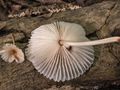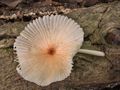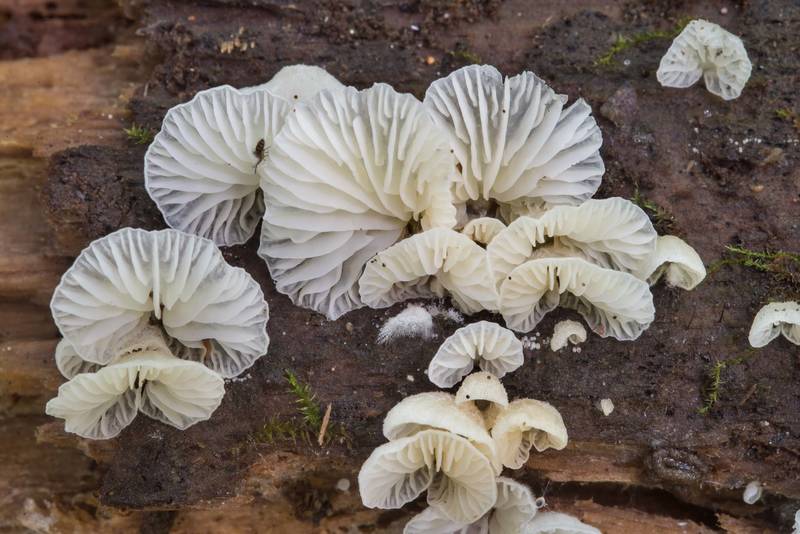
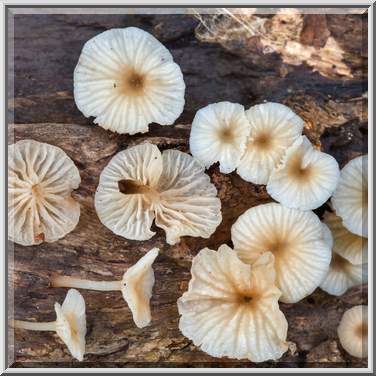
Gills of Marasmiellus mushrooms on rotting wood on Caney Creek Trail (Little Lake Creek Loop Trail) in Sam Houston National Forest, near Huntsville. Texas


Album 2357: Caney Creek area of Sam Houston Forest, Texas, September 15, 2018
The image captures a close-up view of Marasmiellus mushrooms growing on rotting wood, showcasing their distinctive features and habitat.
**Mushroom Characteristics:**
* The mushrooms have white gills that are densely packed and fan-shaped.
* They appear to be small in size, with the largest visible specimen not exceeding 1-2 inches (2.5-5 cm) in diameter.
* The caps of the mushrooms are not visible in this image, but they are likely to be small and bell-shaped.
**Growth Environment:**
* The mushrooms are growing on a decaying log or branch, which is brown and weathered.
* Small patches of green moss or lichen can be seen on the wood around the mushrooms.
**Background:**
* The background of the image is blurry, but it appears to be a forest floor with fallen leaves and twigs scattered about.
* Some other types of fungi may also be present in the background, although they are not clearly visible due to the focus being on the Marasmiellus mushrooms.
**Overall Impression:**
The image provides a detailed view of the unique characteristics of Marasmiellus mushrooms and their ability to thrive in damp environments. The close-up perspective highlights the intricate details of the mushroom's gills and cap, while also showcasing its growth habitat amidst decaying wood and other forest organisms. – AI vision
🇪🇸 Descripción en español / Spanish Description
Los lóbulos de los hongos Marasmiellus en madera podrida en el Caney Creek Trail (Little Lake Creek Loop Trail) en la Sam Houston National Forest, cerca de Huntsville, Texas, el 15 de septiembre de 2018. La imagen captura una vista de primer plano de hongos Marasmiellus creciendo en madera podrida, mostrando sus características distintivas y hábitat. **Características del hongo:** * Los hongos tienen lóbulos blancos que están densamente empaquetados y con forma de abanico. * Parecen ser pequeños, con el mayor espécimen visible no superando 1-2 pulgadas (2,5-5 cm) de diámetro. * Las tapas de los hongos no son visibles en esta imagen, pero es probable que sean pequeñas y con forma de campana. **Entorno de crecimiento:** * Los hongos están creciendo en un tronco o rama podrido, que es marrón y desgastado. * Se pueden ver pequeños parches de musgo verde o líquen sobre la madera alrededor de los hongos. **Antecedentes:** * El fondo de la imagen está borroso, pero parece ser un suelo forestal con hojas caídas y ramitas esparcidas. * Algunos otros tipos de hongos pueden estar presentes en el fondo, aunque no son claramente visibles debido al enfoque que se centra en los hongos Marasmiellus. **Impresión general:** La imagen proporciona una vista detallada de las características únicas de los hongos Marasmiellus y su capacidad para prosperar en entornos húmedos. La perspectiva de cerca destaca los detalles intrincados de los lóbulos y la cubierta del hongo, al tiempo que también muestra su hábitat de crecimiento entre madera podrida y otros organismos forestales. – Spanish translation