
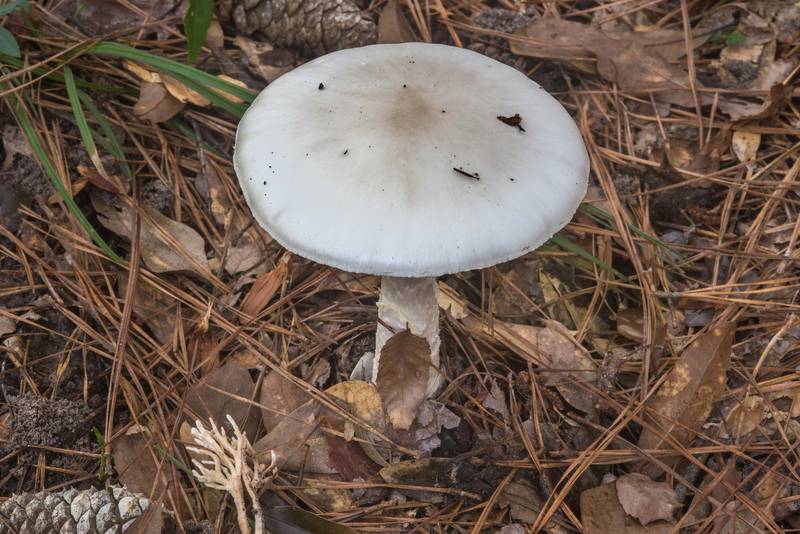

Death cap mushroom (Amanita sect. Phalloideae) in Big Creek Scenic Area of Sam Houston National Forest. Shepherd, Texas


Album 2389: Mushrooms in Sam Houston Forest, Texas, October 28, 2018
The image showcases a prominent white death cap mushroom (Amanita sect. Phalloideae) situated amidst a bed of fallen leaves and pine needles on the forest floor. The mushroom's cap is a striking feature, measuring approximately 4 inches in diameter.
**Mushroom Description**
* **Cap:** White with a slightly off-white center
* **Stalk:** White, approximately 3-4 inches tall
* **Gills:** Not visible due to the angle of the photo
The mushroom is surrounded by dry leaves and pine needles, indicating that it has likely been present for some time. The overall scene suggests a forest environment with an abundance of natural debris on the ground.
**Background**
The surrounding foliage appears to be a mix of deciduous and evergreen trees, with fallen branches and leaves scattered throughout the area. The presence of pine needles suggests that there may be nearby pine trees contributing to the forest's ecosystem.
**Conclusion**
Overall, the image provides a detailed view of a death cap mushroom growing in its natural habitat, surrounded by the remnants of fallen foliage. – AI vision
🇪🇸 Descripción en español / Spanish Description
El hongo de la trompeta de la muerte (Amanita sect. Phalloideae) en el área escénica de Big Creek del bosque nacional Sam Houston. Shepherd, Texas, 28 de octubre de 2018. La imagen muestra un prominente hongo blanco de la trompeta de la muerte (Amanita sect. Phalloideae) situado entre una cama de hojas caídas y agujas de pino en el suelo del bosque. El sombrero del hongo es una característica destacada, midiendo aproximadamente 4 pulgadas de diámetro. **Descripción del hongo** * **Sombrero:** Blanco con un centro ligeramente blanquecino * **Tallo:** Blanco, aproximadamente de 3-4 pulgadas de altura * **Poros:** No visibles debido al ángulo de la foto El hongo está rodeado de hojas secas y agujas de pino, lo que indica que probablemente ha estado presente durante algún tiempo. La escena general sugiere un entorno forestal con una abundancia de restos naturales en el suelo. **Antecedentes** El foliaje circundante parece ser una mezcla de árboles de hoja caduca y perennes, con ramas caídas y hojas dispersas por toda la zona. La presencia de agujas de pino sugiere que puede haber árboles de pino cercanos que contribuyen al ecosistema del bosque. **Conclusión** En general, la imagen proporciona una vista detallada de un hongo de la trompeta de la muerte creciendo en su hábitat natural, rodeado por los restos de las hojas caídas. – Spanish translation


