
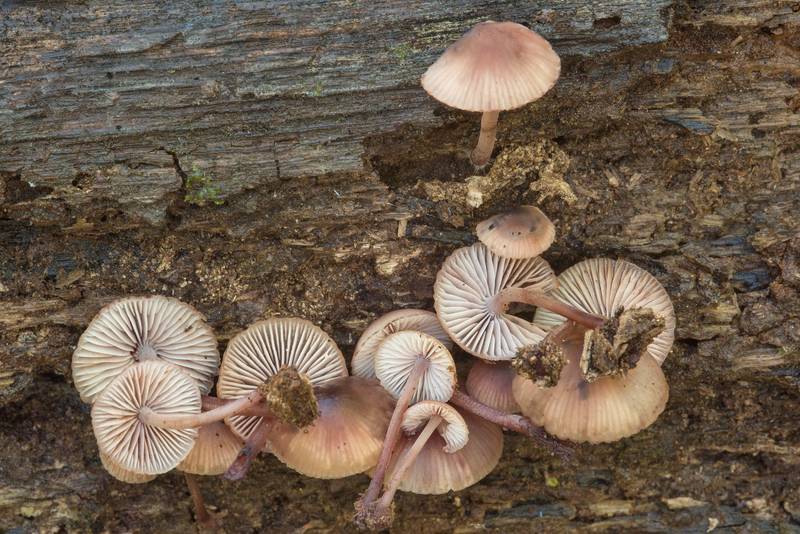

Burgundydrop bonnet mushrooms (Mycena haematopus) on an oak log on Caney Creek Trail (Little Lake Creek Loop Trail) in Sam Houston National Forest near Huntsville. Texas


Album 2393: Sam Houston Forest, Texas, November 4, 2018
The image shows a close-up of mushrooms growing on an oak log. The mushrooms are small, with rounded caps that have a smooth texture and a burgundy color. The stems are thin and brownish-red, and they are attached to the cap at the center.
The background of the image is the bark of the oak tree, which is rough and weathered. There are some other plants growing on the log as well, including mosses and lichens.
Overall, the image suggests that the mushrooms are growing in a natural environment, possibly in a forest or woodland area. The presence of other plants and the weathered appearance of the oak tree suggest that this is a mature ecosystem with a long history of growth and development.
The image also highlights the importance of preserving and protecting these types of ecosystems. The oak tree and the mushrooms that grow on it are an important part of the natural environment, and they play a crucial role in maintaining the balance of the ecosystem. By preserving these areas, we can help to ensure that future generations will be able to enjoy their beauty and benefits.
In terms of visual composition, the image is well-balanced and easy to look at. The mushrooms are placed prominently in the center of the frame, with the oak tree bark serving as a subtle background. The use of natural light adds depth and dimension to the image, making it feel more dynamic and engaging. Overall, the image is visually appealing and effectively conveys the beauty and importance of these types of ecosystems.
In terms of technical composition, the image appears to have been taken with a high-quality camera or smartphone. The resolution is clear and sharp, allowing for good detail in both the foreground and background. The lighting is natural, which helps to bring out the colors and textures of the mushrooms and oak tree bark. The focus is well-executed, with the mushrooms and stems clearly defined.
Overall, the image is a great example of how photography can be used to capture and share the beauty of nature. It highlights the importance of preserving and protecting our natural environments, while also showcasing the unique characteristics and features of these ecosystems. – AI vision
🇪🇸 Descripción en español / Spanish Description
Hongos de copete del Bugdud (Mycena haematopus) en un tronco de roble en el Caney Creek Trail (Little Lake Creek Loop Trail) en la Sam Houston National Forest cerca de Huntsville, Texas, el 4 de noviembre de 2018. La imagen muestra una vista cercana de hongos creciendo sobre un tronco de roble. Los hongos son pequeños, con sombreros redondeados que tienen una textura suave y un color borgoña. Los tallos son delgados y marrones-rojizos, y están unidos al sombrero en el centro. El fondo de la imagen es la corteza del árbol de roble, que es rugosa y desgastada. También crecen otras plantas sobre el tronco, incluyendo musgos y líquenes. En general, la imagen sugiere que los hongos están creciendo en un entorno natural, posiblemente en un bosque o área arbolada. La presencia de otras plantas y la apariencia desgastada del árbol de roble sugieren que se trata de un ecosistema maduro con una larga historia de crecimiento y desarrollo. La imagen también resalta la importancia de preservar y proteger estos tipos de ecosistemas. El árbol de roble y los hongos que crecen sobre él son una parte importante del entorno natural, y desempeñan un papel crucial en el mantenimiento del equilibrio del ecosistema. Al preservar estas áreas, podemos ayudar a garantizar que las generaciones futuras puedan disfrutar de su belleza y beneficios. En términos de composición visual, la imagen está bien equilibrada y fácil de mirar. Los hongos están colocados prominentemente en el centro del encuadre, con la corteza del árbol sirviendo como fondo sutil. El uso de luz natural añade profundidad y dimensión a la imagen, dándole una sensación más dinámica y atractiva. En general, la imagen es visualmente atractiva y transmite eficazmente la belleza e importancia de estos tipos de ecosistemas. En términos de composición técnica, la imagen parece haberse tomado con una cámara o smartphone de alta calidad. La resolución es nítida y clara, lo que permite un buen detalle tanto en el primer plano como en el fondo. La iluminación es natural, lo que ayuda a destacar los colores y texturas de los hongos y la corteza del árbol. El foco está bien ejecutado, con los hongos y tallos definidos claramente. En general, la imagen es un buen ejemplo de cómo se puede utilizar la fotografía para capturar y compartir la belleza de la naturaleza. Destaca la importancia de preservar y proteger nuestros entornos naturales, al tiempo que pone de manifiesto las características y detalles únicos de estos ecosistemas. – Spanish translation


