
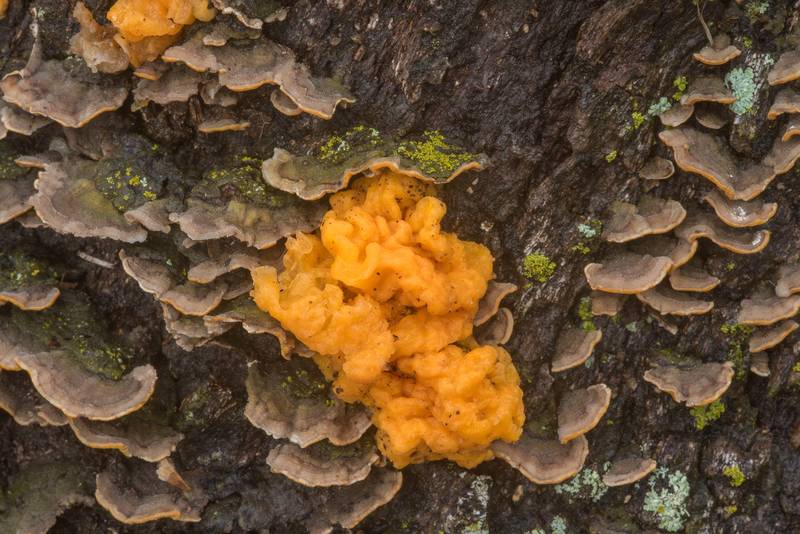

Jelly fungus Tremella aurantia mushroom parasitizing Stereum on an oak in City Cemetery. Bryan, Texas


Album 2425: College Station - Bryan, Texas, January 1 - 3, 2019
The image showcases a striking scene of fungi growth, with a vibrant orange jelly fungus (Tremella aurantia) parasitizing a Stereum on an oak tree in City Cemetery, Bryan, Texas, captured on January 3, 2019.
* **Fungal Growth**
* The image is dominated by the striking yellow-orange hue of Tremella aurantia, which appears as a gelatinous mass covering a significant portion of the Stereum's surface.
* The fungus has formed irregularly shaped lobes and ridges, giving it a distinctive appearance.
* **Stereum**
* The Stereum is visible in the background, providing a contrasting texture to the smooth, gelatinous Tremella aurantia.
* Its surface appears rougher than that of the Tremella aurantia, with more pronounced ridges and grooves.
* **Oak Tree**
* The oak tree trunk provides a dark brown backdrop for the fungal growths.
* The bark is visible in some areas, adding texture to the image.
**Summary**
The image captures a unique moment of fungal symbiosis between Tremella aurantia and Stereum on an oak tree. The vibrant orange coloration of Tremella aurantia stands out against the duller tones of the surrounding fungi and tree trunk. – AI vision
🇪🇸 Descripción en español / Spanish Description
El hongo de gelatina Tremella aurantia parasitando el Stereum en un roble del Cementerio Municipal. Bryan, Texas, 3 de enero de 2019. La imagen muestra una escena impactante de crecimiento fúngico, con un hongo de gelatina naranja vibrante (Tremella aurantia) parasitando a un Stereum en un roble en el Cementerio Municipal de Bryan, Texas, capturado el 3 de enero de 2019. * **Crecimiento fúngico** * La imagen está dominada por la llamativa tonalidad amarillo-naranja de Tremella aurantia, que aparece como una masa gelatinosa cubriendo una parte significativa de la superficie del Stereum. * El hongo ha formado lóbulos y aristas de forma irregular, dándole un aspecto distintivo. **Stereum** * El Stereum es visible en segundo plano, proporcionando una textura contrastante con la superficie suave y gelatinosa de Tremella aurantia. * Su superficie parece más áspera que la de Tremella aurantia, con aristas y surcos más pronunciados. **Roble** * El tronco del roble proporciona un fondo marrón oscuro para los crecimientos fúngicos. * La corteza es visible en algunas áreas, añadiendo textura a la imagen. **Resumen** La imagen captura un momento único de simbiosis fúngica entre Tremella aurantia y Stereum en un roble. El color naranja vibrante de Tremella aurantia destaca contra los tonos más oscuros del hongo circundante y el tronco del árbol. – Spanish translation


